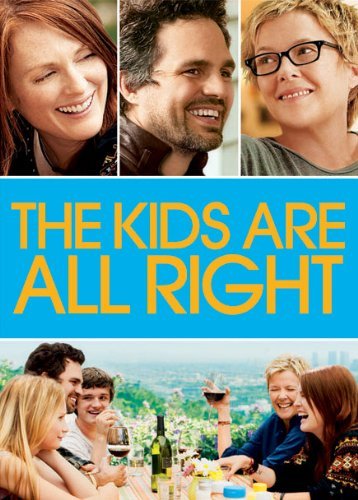
In an ideal world, queer films would be authentic, inclusive, and capture honest LGBT+ experiences without having to be sanitized for mainstream audiences. Unfortunately, this is usually not the case as queer films are often forced tailor their stories to white, heterosexual viewers to even be made. The 2010 film, The Kids Are All Right is no different. Despite having a lesbian couple front and center, the film “does not contest dominant heteronormative assumptions and institutions but upholds and sustains them” (Duggan 179). The movie weighs heavily on the side of assimilation as it pushes the notion of “gay families are just like yours.” In doing so, The Kids Are All Right presents a story that is essentially made for straight audiences, rather than the people it is actually depicting on screen.

The movie tells the story of Jules (Julianne Moore) and Nic (Annette Bening), who are married and have two children–Joni (Mia Wasikowska), who is 18 and about to leave for college, and Laser (Josh Hutcherson), who is 15. Since Joni is now 18, she and Laser become curious about their sperm donor father. The two siblings quickly get into contact with their father, Paul (Mark Ruffalo) and after meeting once, Paul knows that he wants to be part of their lives. While the kids initially try to keep this relationship a secret, their mothers eventually find out and they too want to meet Paul. Nic is extremely apprehensive toward Paul’s presence in and around her family, while Jules takes a job remodeling his backyard and eventually begins having an affair with him. The rest of the film deals with Jules and Paul attempting to hide the affair and the eventual discovery of it by their family and what it does to this unit as a result.

From the opening scene, the film pushes the agenda of “we’re just like you” as a means to connect with mainstream audiences and to make the story they are viewing more palatable. The family is even given traditional roles to establish this common ground. Nic is a doctor and the breadwinner of the family, but she also takes on a traditional disciplinarian role, much like a father would in a straight, nuclear family. Jules, on the other hand, is the housewife set on starting her own business. She takes on the more nurturing role in regards to her and Nic’s children. Due to this, the film becomes no different than any of the other hundreds of comedy-dramas that have been released in the past several decades. The only slight variation is that this time, the marriage involves two women.
While this is not to say that this movie is a completely inaccurate representation of a lesbian marriage, the performance of it does feel overdone. It often felt as though the film was attempting to make straight audiences as comfortable as possible by not straying from the family dynamics they themselves practice. The movie was a hit among straight audiences, being nominated for multiple awards and even winning several of them. While it should be celebrated that a queer film was well-received by mainstream audiences, in this case, it merely allowed Hollywood to give themselves a pat on the back for being “inclusive” and allowing for a film about lesbians to receive visibility. They felt that, as a result, LGBT+ representation was no long an issue in the film industry, failing to account for the fact that this film is heavily sanitized for straight viewers.
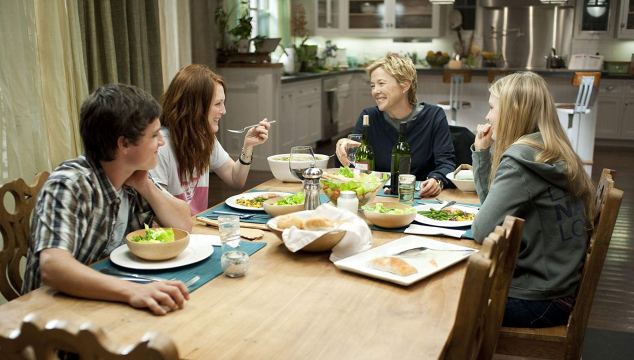
To make matters worse, despite Jules being a lesbian, she still has an affair with Paul. This main conflict puts forth the notion that, if given the chance, a lesbian will choose to be in a heterosexual relationship. Moreover, it must also be noted how Nic is portrayed throughout the entire film. It feels as though viewers are made to dislike Nic, so that they can sympathize with Jules and justify why she had an affair. They fail to see that, even if Jules was feeling underappreciated, there are alternate avenues through which to handle the situation–one of which is not sleeping with your sperm donor. Jules’ choices are not only inexcusable, but they also suggest that mainstream audiences would rather see a straight affair instead of a healthy and loving same-sex marriage.

The movie does not delve into any real issues that it presents, sometimes choosing to not even address these issues at all. The entire film is surface level and lacks development as conflicts are introduced and then never returned to again. For instance, there appears to be a budding relationship between Joni and her friend Jai (Kunal Sharma). Yet, after making out at a party, nothing about Jai is ever mentioned again. This relationship is never discussed or unpacked more, thus leaving audiences without answers and often wondering why the potential romance was even brought up in the first place.
Furthermore, issues presented in the film are left unresolved simply because they are never fully addressed. After Jules’ affair with Paul is discovered, she and Nic obviously have a lot of issues that need to be worked out. Jules ends up sleeping on the couch for a while and then gives a heartfelt speech to her entire family as an apology. However, it is never explicitly stated or shown if Jules and Nic truly make up. The final scenes simply show them dropping Joni off at college and holding hands on the drive home. Even when Laser makes a comment about why they should not split up, they both just smile, therefore viewers can only assume they have reconciled. Due to this lack of development with characters and scenes, the film made it impossible to connect with or relate to any character, which in turn made the film seem even more superficial.

While many conflicts were introduced and then never referenced again, some issues within the film were not even addressed at all, with the most glaringly obvious of these being the blatant racism. The main cast for the film is entirely white and the few characters of color that do make an appearance on screen can be counted on one hand. As Richard Dyer points out in his chapter, “The Matter of Whiteness,” “[a]t the level of racial representation, in other words, whites are not of a certain race, they’re just the human race” (11). White people are typically seen as just “people,” whereas P.O.C. are raced and thus labelled as “something else” or “other,” and the film uses this notion to make the characters of color completely disposable. Luis (Joaquín Garrido), the gardener Jules hires to help with her landscaping business realizes that Jules and Paul are having an affair. Even though he gives no indication that he will use this information against her, Jules nevertheless “recognizes that he has too much power” (Kennedy 127). To assert her superiority and dominance over him, Jules decides to fire him on the spot, leaving no room for negotiation.
Another character of color that gets easily glossed over is Tanya (Yaya DaCosta), one of Paul’s employees that he sleeps with on a regular basis. After starting an affair with Jules and realizing that he is falling for her, Paul decides to break things off with Tanya since he does not believe she is ready to start a family like he is. Even though Tanya has always been supportive of Paul, especially in his relationship with his kids, he still chooses to leave her “because she cannot compete with the heteronormative white ideal in [his] mind” (127). Both Luis and Tanya are easily dumped by the white characters in the film, either being wrongly fired or coldly broken up with. This illustrates how, unless characters of color are of immediate use to their white counterparts, they are deemed worthless and indefinitely cast aside as a result.

Prior to the literal disposal of Luis and Tanya’s characters, both of them are made subject to casual racism from the other characters. Paul mocks the way Luis talks as a way to flirt with Jules, and before she fires him Jules accuses Luis of having a drug problem, when it is actually just his allergies. As for Tanya, Joni’s friend Sasha (Zosia Mamet) first asks Tanya if she got her necklace from Africa, then proceeds to ask if she is from Africa. These racist remarks are merely glossed over and they are never called out even if others are present. The film attempts to hide behind the guise of comedic relief or filler dialogue when it comes to this racism, as those present simply laugh off the prejudiced comments from their fellow white characters if not ignore them altogether. As a result, the film not only caters to just straight audiences, but white ones as well.
It would be harsh to say that this film does not provide any accurate depiction of what a lesbian marriage is like, as the film’s writer and director, Lisa Cholodenko, is a lesbian mother who is in a long-term relationship. Therefore, the film likely does provide some truth in regards to the particular relationship it displays. However, it is still problematic in the fact that it presents a family dynamic that is nearly identical to the straight families depicted in movies and on televisions every day. Furthermore, pertinent issues regarding LGBT+ people and P.O.C. are never fully addressed or even given a second thought. The fact that this film did so well at the box office and award shows suggests that mainstream viewers will only watch a same-sex marriage if it is heavily sanitized. Many believed that the film’s success was the start of straight viewers finally accepting and supporting same-sex relationships. However, the movie likely did well simply because it portrays a lesbian relationship that so closely resembles that of a straight family. Had the film strayed from this set-up, I highly doubt straight, white audiences would have been as welcoming as they were of this film. While acceptance is immensely important, even crucial, it should come without queer people’s experiences having to be sanitized for mainstream audiences for fear of upsetting them.

Works Cited
Duggan, Lisa. “The New Homonormativity: The Sexual Politics of Neoliberlism.” Materializing Democracy: Toward a Revitalized Cultural Politics, edited by Russ Castronovo and Dana D. Nelson. Duke University Press, 2002, 175-194.
Dyer, Richard. “The Matter of Whiteness.” White Privilege: Essential Readings on the Other Side of Racism, edited by Paula Rothenberg. Worth Publishers, 2002, 10-14.
Kennedy, Tammie M. “Sustaining White Homonormativity: The Kids Are All Right as Public Pedagogy.” Journal of Lesbian Studies, Routledge, 2014, 118-132.
The Kids Are All Right. Directed by Lisa Cholodenko. Performances by Annette Bening, Julianne Moore, Mark Ruffalo, Mia Wasikowska, and Josh Hutcherson. Focus Features, 2010.

 Queer Cinema
I absolutely loved this analysis! You’re right to point out that since the director is a lesbian mother in a long-term relationship, some of the experiences depicted here may be true to her life. But still, this isn’t just a home movie, it’s a major feature film going out to a massive audience, and it’s going to shape people’s ideas about lesbian relationships. I’m also glad that you pointed out how many conflicts in the film are ignored or poorly dealt with. This movie felt like a glorified sitcom at times. It didn’t do anything to warrant all the reviews calling it “smart” or “an honest portrayal of marriage.”
LikeLiked by 1 person
The way they juxtapose the comical and unsatisfying sex scene with Jules and Nic and the sensual and lengthy sex scenes with Jules and Paul is all too telling about how “progressive” this film is. The fact that the women were watching gay porn while having sex (which a straight mainstream audience would laugh at) is hard to process as anything but a mockery of lesbian women. The film shared a lot more about the horrible tastes of mainstream audiences than any actual accurate portrayal of queer characters.
LikeLiked by 1 person
I agree with you, only so many things can stray from the norm before people start to freak out. If the filmmakers hadn’t made this film so sanitized and similar to straight relationships, it would have been TOO different. Straight audiences just aren’t ready for that yet, especially an audience of this scale. Queer relationships deserve to be portrayed honestly and realistically, and this movie just does not hit that mark.
LikeLiked by 1 person