
December 1st was World AIDS Day, just as it has been for every year since 1988. This year, however, a day that was supposed to be dedicated to remembrance and raising awareness of a disease that has claimed countless lives was overshadowed by another event. One day prior, on November 30, 2018, George H.W. Bush died. The fact that the 41st U.S. President’s death seemed to take precedent over World AIDS Day is rather ironic considering his stance on the matter. Upon hearing the news of his passing, many felt it was necessary to remember Bush’s legacy, completely disregarding the negative aspects of his administration, especially in regards to HIV/AIDS.
While in office, Bush pledged a better approach to the AIDS crisis than his predecessor, Ronald Reagan, but when he gave a speech on the subject in 1990 he “was long on compassion but short on strategy and commitment to funding” (Signorile). Despite Bush’s negligence toward the virus and those living with and effected by it, in the wake of his death his mourners attempted to portray him in a positive light, wanting to only note his accomplishments. Simultaneously, they chose to completely ignore the hundreds of thousands that died due to utter carelessness from Bush and his entire administration. The close proximity of these recent events merely serves as a modern example of how elected officials have remained silent when it comes to HIV/AIDS, and furthermore, how they are never held accountable for their actions, or rather their lack thereof.
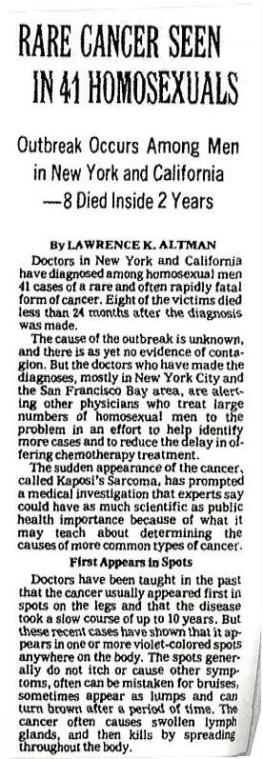
Although the first cases began showing up among gay men in the late 1970s, the United States Center for Disease Control and Prevention (CDC) did not issue a warning about what would later be known as AIDS until 1981. That same year, The New York Times published an article announcing: “Rare Cancer Seen in 41 Homosexuals.” Initially calling it “Gay Cancer,” the name of the disease was soon changed to GRID or Gay-Related Immune Deficiency (“GMHC/HIV/AIDS Timeline”). At the time, virtually nothing was known about the disease other than that it primarily affected gay men, making them susceptible to “germs that normally wouldn’t hurt a baby” (The Normal Heart). Doctors had no idea how the virus was spread, nor how to stop its rapid progression in patients. To make matters worse, elected officials offered no guidance for how to deal with what the CDC had by then declared an epidemic. Despite more cases being reported daily, with seemingly no end in sight, politicians refused to discuss the matter publicly. In fact, it was not until September 1985 that President Ronald Reagan mentioned AIDS publicly for the first time. Although, this response was insufficient as, by this point, thousands had already died or been infected, while the president had failed to provide any feasible solutions to the crisis.
While this disease was beginning to unfold, writer and activist Larry Kramer was witnessing its effects firsthand. Countless members of his community were dying and he saw that no one in power was taking direct action. As a result, Kramer was compelled to co-found the Gay Men’s Health Crisis (GMHC) in 1982. With a mission to end the AIDS epidemic and uplift all those affected by the disease, the GMHC worked to create change by finding and funding treatments to counteract the virus. However, due to a difference of opinions and strategies, Kramer was eventually removed from the GMHC. Shortly thereafter, he wrote the play The Normal Heart, not only to recount his experiences amid the AIDS crisis, but more importantly to chronicle the U.S. Government’s lack of involvement when it came to battling the disease.

Based on Kramer’s 1985 play of the same name, the 2014 television drama film, The Normal Heart, follows the onset and subsequent rise of the AIDS crisis from 1981 to 1984. Largely autobiographical in nature, the film takes place in New York City, detailing the efforts of the GMHC, particularly through the eyes of the film’s protagonist, Alexander “Ned” Weeks (Mark Ruffalo). Ned, like Kramer, is a writer turned activist that watches, horrified, as those in his community rapidly die from an unknown disease. When his partner, Felix Turner (Matt Bomer), contracts the virus, the fight becomes all the more personal for Ned. Desperate to save Felix, and outraged by the government’s absence in the matter, Ned is determined to not only find a cure, but to make AIDS the nation’s top priority.

Ned feels that loud, public confrontations and consistent media coverage will warrant results while peaceful cooperation simply makes it easier for the government to ignore the issue entirely. As those in power tried to suppress all aspects of the disease, it merely continued to spread, taking more lives as time passed. Ned is blatant and bold in his articles and letters, refusing to censor any aspect of the virus, whereas elected officials choose to not discuss the disease whatsoever, acting as though it does not exist. The longer these officials refuse to talk about and take action against AIDS and its effects, the worse the epidemic becomes. By equating silence with stagnation as well as leaving viewers with an ambiguous ending, The Normal Heart argues that the lack of discussion regarding HIV/AIDS is what has ultimately allowed the virus to remain a threat, both in the 1980s and even today in 2018.
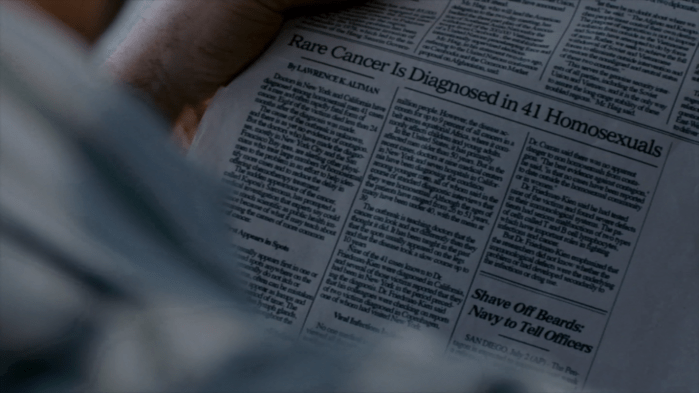
From the beginning of the film, the lack of reporting about AIDS is what causes the disease to be transmitted and thus progress so quickly. The first time Ned hears of the virus is when he is reading The New York Times article mentioned earlier. This story is not on the front page, but rather it is only given a small column inside the paper. This placement alone allows the disease to be ignored as many would completely skim over the article unless they were reading the newspaper from cover to cover. Soon after Ned reads the article about AIDS, he contacts Felix, who is a New York Times reporter. Seeing as how they were the company to originally release information regarding the virus, Ned hopes that his connection with Felix will result in more stories about AIDS being published. Unfortunately, Felix says the attitude at The New York Times is like most other newspapers, as both of them know that media outlets tend stay away from gay issues because there is “too much room for criticism” (The Normal Heart).

Reporters often feared they would lose their jobs or be subject to harsh judgement from the public if they covered AIDS or any topic related to the gay community. Along with this, those who did not experience the direct effects of the health crisis did not see a reason to inform others or themselves about it, feeling as though they were immune to it. As a result, Ned and other members of the GMHC must take to the street for donations as they try to spread information about the disease via word of mouth. Despite getting articles published in the New York Native, a smaller scale, gay newspaper, they are still unsuccessful in their attempts at raising awareness. Even those that do take a copy of the newspaper seldom read its contents. Instead they simply discard the paper into the nearest trashcan, having only taken a copy to get the members of the GMHC to leave them alone.

Much like passersby that took the GMHC’s papers only to throw them away, those in power often feigned interest as a means to keep activists content, if only for the time being. This approach further silenced the AIDS epidemic as officials typically felt that if they ignored the issue long enough the problem would, quite literally, die off. Ned’s homophobic brother, Ben Weeks (Alfred Molina), is one of the first characters to employ this strategy. Ben is a lawyer and the senior partner at his firm. Ned knows that not only would the law firm be able to afford and advise the GMHC pro bono, but that his brother could greatly influence this decision. Even though Ben tells Ned that he will bring up this possibility at the next meeting, Ned realizes this promise is only said to make him drop the matter, as his brother still thinks Ned is sick for being gay.
When those in power are not dismissing the impending threat of AIDS, they utilize red tape tactics to deter activists’ efforts in hopes that they will eventually abandon their cause altogether. Whether it be through put-off requests or a mountain of paperwork, officials use these “necessary” procedures so they can continue to remain silent. For instance, it took the GMHC well over a year to get a meeting with Hiram Keebler (Denis O’Hare), the mayor’s assistant, and even then he was an hour and a half late. The meeting takes place in a remote and dimly lit basement, suggesting that the mayor wants to keep this encounter as secret as possible. To appease the GMHC members, Mr. Keebler tells them just how much the mayor cares and is impressed by how well they are shouldering their own responsibilities. Yet, when Ned begins demanding answers and assistance, Mr. Keebler’s tone abruptly changes. He tells them that “315 cases doesn’t seem too high” and that both he and the mayor think they are simply “overreacting” (The Normal Heart).
This strategy continues to be employed when Dr. Emma Brookner (Julia Roberts) applies to receive AIDS research funding from the government. Her first reported case occurred three years ago and the National Institutes of Health (NIH) received her initial request over two years ago, to which it took them nearly a year to print and send applications. Dr. Brookner notes how, in the past, the government has spent $3 million investigating seven deaths from Tylenol, therefore, the AIDS crisis and its some 2,000 cases should assuredly receive funding.

Despite this, however, the board still votes to reject her application for funding. Along with saying that her research is “imprecise and unfocused,” the examining doctor (Remy Auberjonois) argues that the government receives more requests than they can possibly grant funding to. After going through the grueling process of filling out the appropriate forms and then having to patiently wait for the government’s response, Dr. Brookner’s appeal is still denied. This blatant rejection illustrates how these departments and their members merely hide behind the guise of caring only to repeatedly let down those in dire need of assistance. Without the proper funding, Dr. Brookner will no longer have the means to adequately research the disease. Halting Dr. Brookner’s studies ensures that she cannot release any new information regarding the virus. Although the examining doctor claims there are other researchers studying this disease, there is no guarantee that this is actually the case, which is yet another way the government works to suppress the AIDS epidemic.
Although they momentarily provide a glimmer of hope, it is soon revealed just how empty elected officials’ promises truly are. When Ned receives a call from the White House, he believes the GMHC’s cause is finally gaining some momentum and that, at last, the AIDS crisis will reach a solution. Unfortunately, he is met with similar opposition that he has faced thus far in the film. Instead of meeting with the president directly, Ned has an appointment with the Advisor to the President, John Bruno (Corey Stoll). When Ned mentions how AIDS is a plague, Mr. Bruno discourages him from using such a “negative term” as it only “scares people” (The Normal Heart). He goes on to reassure Ned that he is consistently introducing new ideas to the president, to which Ned replies, “what we desperately need is for somebody to help us cut through all this red tape” (The Normal Heart). Rather than answering Ned’s plea, the advisor simply places more obstacles in his path.

It then becomes clear that ulterior motives are at work within this meeting. The advisor merely wants confirmation that straight, “regular” people cannot contract AIDS. He claims that there is “not a single documented case of a heterosexual man getting it,” (The Normal Heart), frantically searching for affirmation as he, like so many others, believes that if the disease does not affect straight people, then there is no need for alarm nor action. When Ned says that he does not have that information, the advisor promptly ends the meeting as he has not received the news he was hoping for.
In all three cases (with the mayor’s assistant, the examining doctor, and the president’s advisor), each individual made either the GMHC or Dr. Brookner feel as though their cause was not important enough to receive the proper attention or funding. Stating that the government receives too many requests as a reason for not approving the GMHC’s indicates that the AIDS crisis is insignificant to them. Regardless of how many people die, in the minds of the government and numerous American people, those losing their lives are not the ones that matter. By ignoring the issue and not saying anything in regards to AIDS, the government is still sending a message. Their message is actually quite similar to that of anti-LGBT protesters that believe those with AIDS should die as punishment for being gay. Just because politicians communicate this notion through their silence, in a more subtle manner or professional setting, does not make it any less egregious than the picketers standing outside of the GMHC building in the film.

Even when Ned attempts to break through this red tape and make some noise in the process, he is nevertheless silenced by those in more powerful positions. His fellow GMHC members are willing to accept whatever support they can get, no matter how minimal, whereas Ned believes “the only thing [politicians] really respond to is pressure” (The Normal Heart). Ned thus decides to take matters into his own hands, appearing on a variety of talk shows as a way to call out the U.S. Government and its lack of involvement in a national health emergency. On one such occasion, Ned boldly tells a talk show host, “the government is intentionally ignoring this epidemic” (The Normal Heart). In another appearance, Ned presents a similar notion just before he accuses the mayor of being a closeted homosexual, to which the show quickly and frantically cuts out, telling viewers it was due to “technical difficulties.”

Despite Ned’s efforts, he continues to be silenced by those around him. After multiple outbursts at political officials and publishing several articles that are deemed controversial, the GMHC Board votes to have him removed from the organization. This dismissal coupled with the governments lack of reporting are suppression techniques that result in the advancement of the AIDS epidemic. Ned was the only person in the GMHC that fearlessly spoke out about the fact that nothing was being done to alleviate this national health emergency. Therefore, without his presence in the fight, the future for those that are and will be affected by AIDS looks rather dismal.

Shortly thereafter, Ned attends Gay Week at Yale University (an engagement Felix had planned on attending with Ned before he died). While couples dance, the camera slowly pans over to Ned, who is sitting alone watching everyone else as tears fill his eyes. When he attended Yale, there was no such thing as Gay Week as many were not even out yet. Presently, Ned is not only saddened by the fact that this event reminds him of Felix, but also that he cannot even celebrate this newfound liberation and acknowledgement that exists for younger generations. He is no longer a part of the GMHC, therefore, he will not be taken seriously when speaking out about AIDS because he does not belong to a credible organization anymore. Furthermore, he knows that to create any real change, large numbers and support is needed. However, most of his peers have rejected his help, so he can only wonder what will become of this epidemic with no discussion taking place. Although he is pleased to see progress being made in terms of acceptance for the LGBT community, Ned realizes that now a far more serious threat awaits, and with elected officials taking no action, he is fearful, as the fate of future generations is looking bleak.

As the film draws to a close, viewers are left with an ambiguous ending, indicating that the future of AIDS is still unclear. Prior to the credits, the film presents a series of facts and figures that appear on screen all while Tommy Boatwright (Jim Parsons), the executive director of the GMHC, is seen removing cards from his Rolodex. Earlier in the film, while at a friend’s memorial, Tommy talks about how when one of his friends dies he removes their card from the Rolodex on his desk. Rather than simply throwing away the cards, he rubber bands them together and stores them in a drawer, as he states that discarding them “feels too final” (The Normal Heart). The way that Tommy keeps removing cards as the statistics come and go indicates that nothing is being done to stop the AIDS crisis, and people are continuing to die as a result.

The statistics at the end of the film displays how the Reagan administration completely ignored the AIDS epidemic, then presents the disease’s death tolls. If viewers think that positive developments and improved statistics will follow, they are merely waiting for something that will never come as “[t]he credits feel abrupt, with signs of hope, but nothing resembling resolution” (Molloy). The ending of the film is not even slightly triumphant because, while people would like to believe that AIDS is a thing of the past, that is simply not the case.
Presently, more is known about the disease now than ever was in the 1980s and even the early 1990s. HIV, or Human Immunodeficiency Virus, is a lifelong condition that attacks a person’s immune system, making them more susceptible to infections and diseases that their body would normally fight off. AIDS, or Acquired Immune Deficiency Syndrome, is the most severe stage of HIV and usually results in death over time. People with HIV do not always have AIDS, as it typically takes about 10 years for a person with HIV to develop AIDS if they are not receiving any treatment (“HIV/AIDS” qtd. in Hostert).
Since the AIDS crisis first began, what was once an epidemic has now become a pandemic, effecting people around the world. Although additional research has been conducted and there is more information and resources available today, the silence surrounding the disease remains. The disease itself is a silent killer as it can lay dormant in a person’s body, and symptoms tend to be non-existent, sometimes taking 10 years to appear. As of today, about 36.9 million people globally are living with HIV, with more people being infected daily (“Global Statistics”).
Although many would like to believe it, we are far from being considered a post-AIDS society. New treatments, both ones that help manage HIV/AIDS as well as pre-exposure medications, have been developed and released, but “AIDS, while certainly different from before, is not yet over” (Román 282). Simply because issues are not constantly reported on does not mean they cease to exist. Often under the pretense that they do not want to incite worldwide panic, elected officials do not want to discuss AIDS in any capacity. In reality, this silencing technique has been used for decades in hopes that the general public will forget about the matter entirely. That way, the government will not have to deal with the disease or work to find and thus fund solutions.

The Normal Heart serves as a reminder of the painful history endured by the LGBT+ community. While HIV/AIDS is briefly touched on in sex education classes, it is never even mentioned in history courses. Changing this aspect of curriculum in schools would not only be accurate in showing that LGBT+ identities have and will continue to exist, but it would also encourage open discussion on the subject. Throughout the film, those in positions of power attempt to prevent any public dialogue about AIDS from taking place. Due to this impediment, countless lives are lost and audiences soon realize that the other characters are “well within their rights to spend the entire film screaming” (Molloy). The anger felt by characters is thus transferred to viewers and, when combined with the unresolved ending, the film provides a call to action, urging audiences to keep the conversation about HIV/AIDS going because lives literally depend on it. Moreover, viewers are persuaded to hold their elected officials accountable, while also pushing them to take necessary action, as it was their silence and idleness in the past that ultimately led to the death of millions.
Works Cited
affirmedally [Lexi Hostert]. “The War Rages On: A Close Look at ‘How to Survive a Plague.'” Queer Cinema, 8 Sept. 2018, WordPress, https://queercinema.movie.blog/2018/09/08/the-war-rages-on-a-close-look-at-how-to-survive-a-plague/. Accessed 11 Dec. 2018.
“Global Statistics.”HIV.gov, 20 Nov. 2018, https://www.hiv.gov/hiv-basics/overview/data-and-trends/global-statistics. Accessed 11 Dec. 2018.
“GMHC/HIV/AIDS Timeline.” GMHC, http://www.gmhc.org/about-us/gmhchivaids-timeline. Accessed 11 Dec. 2018.
“Julia Roberts The Normal Heart.” YouTube, uploaded by broadwayarchive, 27 May 2014, https://www.youtube.com/watch?v=jlH1QtFuDGk.
Molloy, Tim. “‘Normal Heart’ Review: Ryan Murphy Lets the Awful Facts Speak for Themselves.” TheWrap, 23 May 2014.
Román, David. “Remembering AIDS: A Reconsideration of the Film Longtime Companion.” GLQ: A Journal of Lesbian and Gay Studies, vol. 12, no. 2, 2006: 282-283.
Signorile, Michelangelo. “The Media is Erasing George H.W. Bush’s Catastrophic Harm to LGBTQ People.” HuffPost, 2 Dec. 2018.
“The Normal Heart: Clip #3 (HBO Films).” YouTube, uploaded by HBO, 19 May 2014, https://www.youtube.com/watch?v=HONfmLjf2Ys&feature=youtu.be.
The Normal Heart. Directed by Ryan Murphy. Performances by Mark Ruffalo, Matt Bomer, Taylor Kitsch, Jim Parsons, and Julia Roberts. HBO Films, 2014.





































































 Queer Cinema