
It seems that if a straight, cisgendered actor portrays a gay/lesbian or transgender character on screen they are a shoo-in for at least an Oscar nomination if not a guaranteed win. Viewers often refer to this person as ‘brave’ or ‘courageous’ for taking on such a complex, even “controversial” role. However, they fail to realize LGBT+ people must face judgement and oppression on a daily basis, the way this new Academy Award winner has only pretended to do for a couple hours in a film. In 2017, A Fantastic Woman broke the mold by casting a trans woman to [gasp] play the role of a trans woman. The Chilean film illustrates the harsh realities trans people face, even in the midst of life’s devastating events.

A Fantastic Woman follows Marina Vidal (Daniela Vega), a trans woman who works as a waitress and moonlights as a singer, and her older partner Orlando (Francisco Reyes). After an intimate birthday celebration for Marina, Orlando wakes in the middle of the night, experiencing pain. Even though Marina rushes him to the hospital, he unfortunately dies of a brain aneurysm. Subsequently, Marina attempts to properly grieve, while simultaneously fighting to be recognized as a sincere and significant part of Orlando’s life by his family. The film exhibits how, even in times of grief or trauma, transgender people still struggle to be acknowledged, and thus feel pressure from others to validate not only their gender, but any and all personal relationships as well.
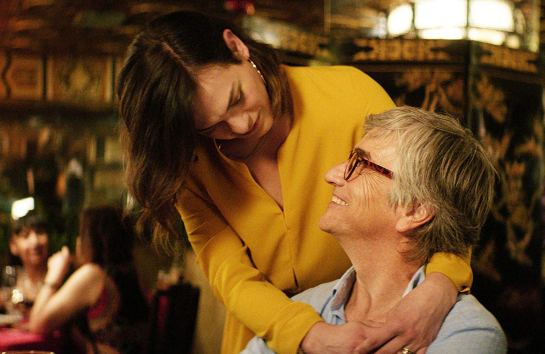
Marina’s once stable life is quickly upended in the wake of Orlando’s death as every private aspect of her life is invaded by the various institutions surrounding her. Panicked and anxiety-ridden at the news of her partner’s death, Marina flees the hospital, which causes the doctor to call the police to retrieve and then question her. Arriving back at the hospital, the police berate and misgender Marina, calling her “sir” and asking to see her I.D. so that they may know her “real name.” Marina is out as a trans woman and strangers generally view her as a cisgendered woman. While she is not “closeted” in the traditional sense, Marina still finds that “every encounter…erects new closets” (Sedgwick 68), where she must assert and defend her gender, along with her general existence.
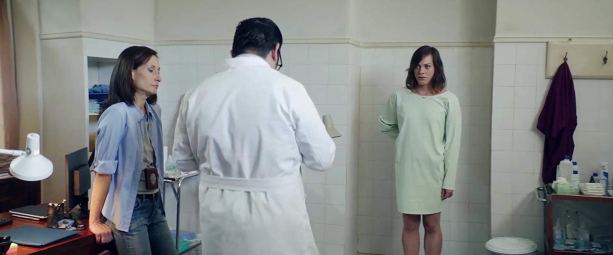
One of the most demeaning and degrading invasions occurs when Marina is photographed by a medical examiner to ensure she did not sustain any injuries on the night Orlando died. This investigation is conducted because a sexual crimes detective (Amparo Noguera) believes the only way to explain the age gap between Orlando and Marina is that the latter is a sex worker. Marina is literally stripped from any remaining privacy she has maintained up until this point as she is forced to stand naked while the medical examiner and detective inspect her, silently scrutinizing her the entire time.
The difficult process of dealing with Orlando’s sudden and shocking death is further complicated when Orlando’s transphobic family becomes involved. Orlando’s ex-wife, Sonia (Aline Küppenheim), and son, Bruno (Nicolás Saavedra) seize almost everything the couple once shared, including his car and dog, Diabla. They attempt to erase Marina’s presence altogether, omitting her from Orlando’s obituary and ordering her to not attend the wake or funeral. Bruno aids in the invasion of privacy when he begins occupying the apartment Marina and Orlando shared, believing he has more of a right to it than she does. In this despicable act Bruno not only breaches Marina’s safe space, but destroys it completely, leaving her with no place to grieve in peace. Due to this, Marina is forced to switch from a mourning mentality to a proactive and demanding one to defend her gender, relationship, and overall place in society with the same guaranteed rights as everyone else.
Despite the various intrusions Marina endures, she exhibits remarkable restraint, proving her grit and resilience. She deflects each and every question and accusation that’s thrown at her, refusing to disclose any more information than she’s comfortable with sharing. However, there are subtle moments where she almost permits Bruno and Sonia’s transphobic demands to take precedent. When Sonia tells her that she is not allowed at the wake or funeral Marina responds, “I know how to be discreet.” In this moment, Marina so desperately wants to be there to mourn Orlando that she is willing to take a backseat to keep Bruno and Sonia comfortable and content.

Marina is constantly correcting hospital personnel, police officers, and Orlando’s family on her gender and name, trying to justify that she is a woman. It is not until she realizes that she will never be able to do so that she ceases these pursuits. In her book, Gender Trouble, Judith Butler writes that “the very injunction to be a given gender takes place through discursive routes…to signify a multiplicity of guarantees in response to a variety of different demands all at once” (145). There is no one precise definition for what a woman is, yet it’s clear that these characters have simply decided that Marina is not it. Marina will never be able to adhere to all of their requirements for womanhood and therefore, every one of her attempts to sway their opinions will be unsuccessful. Proving to them that she is a woman will not bring Orlando back, nor will it provide any closure for her. It’s not until Marina becomes aware of this fact that she begins to focus on her own well-being and happiness rather than Bruno and Sonia’s ignorant thoughts and views.
Despite finding the information in the newspaper, Marina ultimately decides to not attend Orlando’s funeral. She does, however, go to the funeral home after the ceremony. She then follows an employee to the basement of the morgue where she is able to view Orlando’s body just before it’s cremated. While it’s unfair that Marina has no choice but to say her goodbye hidden away in a dimly-lit basement, this scene does represent a turning point within her. Marina is fed up with being pushed in obscurity, so she will no longer be forced into the background of anyone’s life, especially her own.

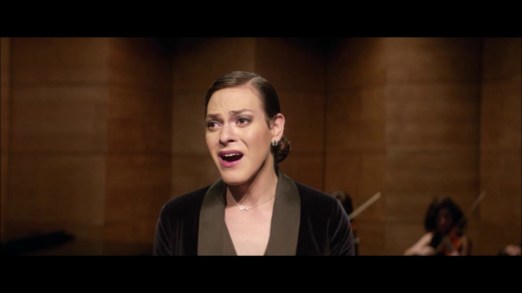
While a part of me hoped Marina would receive more direct justice than she was given, the film proves that Leslie Feinberg’s words ring true: “survival is still a battle for the transgendered population” (220). Marina lived through a traumatic and unwarranted experience and emerged stronger, showing that oftentimes surviving is enough. Despite their attempts to strip and deny Marina of her womanhood, she proved stronger than her oppressors, rising above those that tried to tell her who she was, or even who she was not. The small victories she accomplished along the way were momentous in nature. She not only got Diabla back, but the final scene displays Marina singing to a sold out auditorium. She is center stage during this performance and has thus stepped out of the shadows and fearlessly into the spotlight. This time she is not being questioned or rejected, but admired and accepted for who she is. For the first time in a long time, Marina is not only being seen, but she is being heard. She is a woman, and a fantastic one at that.
Works Cited
A Fantastic Woman. Directed by Sebastian Lelio, Performances by Daniela Vega, Francisco Reyes, Aline Küppenheim, and Nicolás Saavedra, Sony Pictures Classics, 2017.
Butler, Judith. “From Parody to Politics.” Gender Trouble: Feminism and the Subversion of Identity. New York, Routledge, Chapman & Hall, Inc., 1990.
Feinberg, Leslie. “Transgender Liberation: A Movement Whose Time Has Come.” The Transgender Studies Reader, edited by Susan Stryker and Stephen Whittle, Routledge, 2006, 205-220.
Sedgwick, Eve Kosofsky. Epistemology of the Closet. Berkeley and Los Angeles, University of California Press, 1990.

 Queer Cinema
Great review! This movie really did show that trans people constantly have to justify their existence, even when they’re just trying to live from day to day. The immediate dehumanization Marina had to go through was just ridiculous. The police officer who asked for her ID was totally insensitive to the fact that she’d lost a loved one, he only cared about clarifying Marina’s gender. Everyone felt the need to explain something that they didn’t consider “normal,” instead of focusing on what was actually important.
LikeLiked by 1 person
I really like how you cover all aspects of Marina’s struggles in this film! From the intrusive ID check, Bruno asking if shes “had the operation yet”, to unnecessary photographs for the detective… She really is challenged as a woman throughout the entire film – in every way possible! And it makes Marina stronger! Your closing paragraph really pulls on my heart strings, cause that is how I felt seeing the end of this film! It was a beautiful closing, and subtle, showing that Marina is a desired and fantastic woman – as she has been all along!
LikeLiked by 1 person
I think Marina’s ability to retain her strength and resilience is truly remarkable. It’s true, the simple act of surviving really does demonstrate an unmistakable sense of adaptability and strength on Marina’s part. The film leaves the viewer feeling that way too. It doesn’t matter that these people around her are so dead set on hurting her the way they do. All that matters is that Marina is, as you said, finally seen and finally heard.
LikeLiked by 1 person
It always is sad to see cishet people who are put on a pedestal for their “bravery” to take on queer roles. It is fantastic to see a refreshing film like A Fantastic Woman, although it is somewhat sombering to think that it is groundbreaking a transwoman is playing a transwoman in film. I really enjoyed your point about Marina being seen as well as heard. I also think the job had great balance to fetishize her suffering. It felt like a very real experience.
LikeLiked by 1 person