
It’s a well-known fact that lesbian films are few and far between, and the minimal ones that do exist lend themselves to a multitude of stereotypes. Traditionally low-budget, these films have produced cliché notions about lesbians. From the butch/femme relationship, where one woman must be decidedly more masculine than her partner, to the ‘kill or be killed’ trope, in which the lesbian character tragically commits suicide, gets killed, or becomes murderous and thus villainous, these themes work to generalize and disenfranchise lesbians. Due to these exhaustive concepts, the 2015 film Carol was widely welcomed and anticipated because it offered a refreshing lesbian narrative that attempted to diminish many of these previously constructed beliefs. Carol had a budget much higher than its predecessors, of $11.8 million. This increase in association with a mainstream production company “represents a shift in Hollywood’s attitude toward lesbian romance movies” (Landsbaum).
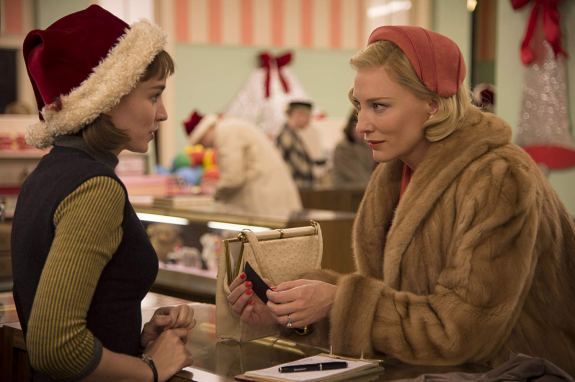
Adapted from Patricia Highsmith’s 1952 novel, The Price of Salt, Carol depicts the relationship that develops between young Therese Belivet (Rooney Mara) and Carol Aird (Cate Blanchett). This budding relationship occurs amidst the societal standards of the time as well as Carol’s impending divorce and subsequent custody battle. Set in “gray-green postwar Manhattan” (White), the film introduces viewers to Therese, a young woman in her 20s that is working in a department store around the holiday season. She has a boyfriend, Richard (Jake Lacy), who pressures her to commit long-term, but the only thing Therese is certain of is that she wants to pursue photography, at one point stating “I barely even know what to order for lunch” (Carol).
Carol, on the other hand, is a well-established housewife whose life seems to vastly differ from Therese’s. She is more experienced and exudes a confidence that Therese lacks, yet longs for nonetheless. However, Therese’s initial assumptions surrounding Carol could not be more wrong. Carol and her husband, Harge (Kyle Chandler) are going through a bitter divorce after he discovers the affair she had with her friend Abby (Sarah Paulson), and when he senses her intention to do the same with Therese, he turns it into a custody suit over their daughter Rindy (Sadie and Kennedy Heim). Carol must therefore hide or repress her sexuality for any hope of keeping her daughter.
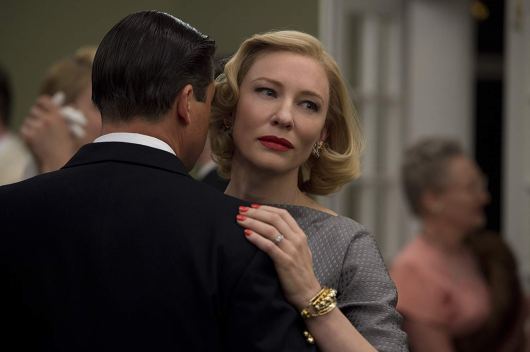
In her chapter, “Art Cinema and Murderous Lesbians, Anneke Smelik writes about how in lesbian relationships there can be movement “back and forth between identification (the wish to be the other) and desire (the wish to have the other)” (75). In Carol, Therese sees stability, poise, and a tenacity she wishes she had, whereas Therese exhibits freedom since she has her whole life ahead of her while Carol feels stuck, even stranded in her current predicament. These women see both their reflection and desire in one another, and additionally the life they yearn to have.
While this film banishes many stereotypes of the past, it is not entirely error-free, giving way to some problematic elements. One of these shortcomings is that the two leading roles are played by straight women. Although, novelist Patricia Highsmith, producer Christine Vachon, scriptwriter Phyllis Nagy, and actress Sarah Paulson are all lesbians, and the production team features numerous women in leadership roles (White). Openly-gay director, Todd Haynes also plays a vital role in the way the film comes across to viewers. Haynes is seen as a trailblazer in regards to the New Queer Cinema movement, and he has become infamous for the picturesque scenes he creates within his films. His 2002 work, Far From Heaven, utilizes saturated colors that are so expressive in nature they almost dictate the entire mood of the scene, as if telling viewers how to feel before action or dialogue even takes place.
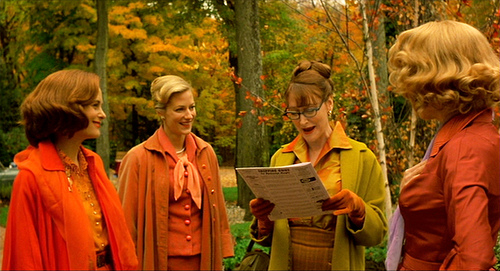
This employment of color as a storytelling device is used inversely in Carol, as the vibrant tones seen in Far From Heaven become muted and more subtle this time around. While still aesthetically pleasing, this softer palette causes the film to adopt a more delicate and nuanced ambience. Nevertheless, in the midst of these quiet settings and backdrops, a bold hue emerges and is visible in almost every scene. Red has been known to symbolize anger, urgency, compassion, and a state of heightened emotion among other things. In this case, it represents Therese and Carol’s love for one another, while also conveying the state of their relationship. Red can be seen in restaurants, lining the streets, and most notably on the women’s clothing, nails, and lips. Studied throughout the film, the color red additionally comes to indicate the change in the structure of Therese and Carol’s relationship.
With every encounter in the film, Carol and Therese’s ensembles are comprised entirely of or at least incorporate red in some way. Carol is more daring in her approach, as she typically wears red dresses and hats while donning lipstick and nails of the same color. As their relationship begins to develop, the color red becomes more prominent in Therese’s wardrobe as well. It’s when Carol invites her on a road trip that Therese wears a full-fledged red sweater, whereas there were only hints of the color in her hats and scarves before. This change in color signifies the progression of Therese’s confidence, as the shades she wears grow bolder from their surroundings so does she.

When their trip is cut short by a private investigator hired by Harge, Carol is forced to either return home or give up custody of Rindy. Her attempt at resuming her life as Harge’s faithful and dutiful wife is shown by the fact that she begins seeing a psychotherapist along with her attire. Her clothing that once contained vibrant red hues has been replaced by subdued tones and her nails are no longer red but clear and transparent, as if proving to Harge that she is no longer hiding anything from him while also indicating the repression of her sexuality.
Several months pass before Carol sees Therese again. She watches from a cab as Therese crosses the street, confidently wearing red. She learns that Therese is working as a photographer for the New York Times, and has therefore established herself career-wise. Therese is now viewed as the unobtainable one, while Carol can do nothing but longingly gaze after her, the way in which she used to be by Therese. This brief occurrence causes Carol to realize that she is willing to make the ultimate sacrifice of giving up custody of her daughter so that she’s able to live her life fully and honestly, asking that she only be allowed to visit Rindy on a regular basis. Carol then writes to Therese, extending an invitation for them to meet, unaware of whether or not her request will be answered.
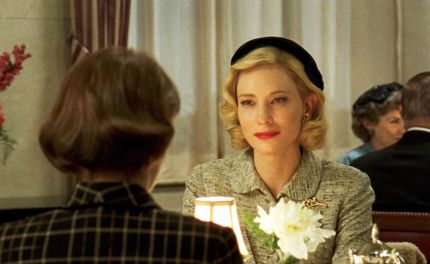
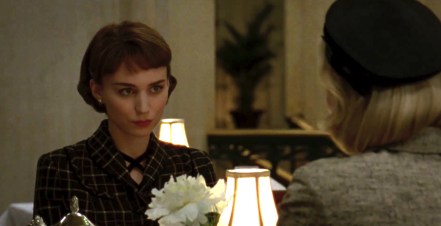
It is then that viewers are brought back to the scene that opened the film, with Carol and Therese sitting together in the lounge of the Ritz Tower Hotel. The narrative that preceded this revisited encounter is now understood as Therese’s flashback, confirming that the film has taken on her perspective. In an interview with Nick Davis, Todd Haynes explains, “We come back, then, not just to experience that scene a second time, but to do so from another character’s perspective.” Initially audiences likely believed Carol was in control of the situation, when in reality Therese is the one being sought after. Therese has a steady job and feels reserved, even mysterious, much like Carol was perceived in the beginning. Carol states that she is taking a job at a furniture house and will be moving into an apartment. She whispers, “I love you,” almost desperately to Therese before they are interrupted. It is now Carol who is vulnerable and left feeling rejected at this exchange. She exits the lounge composed, leaving Therese with a gentle touch on her shoulder as a way to display her sorrow, yet understanding of the situation.

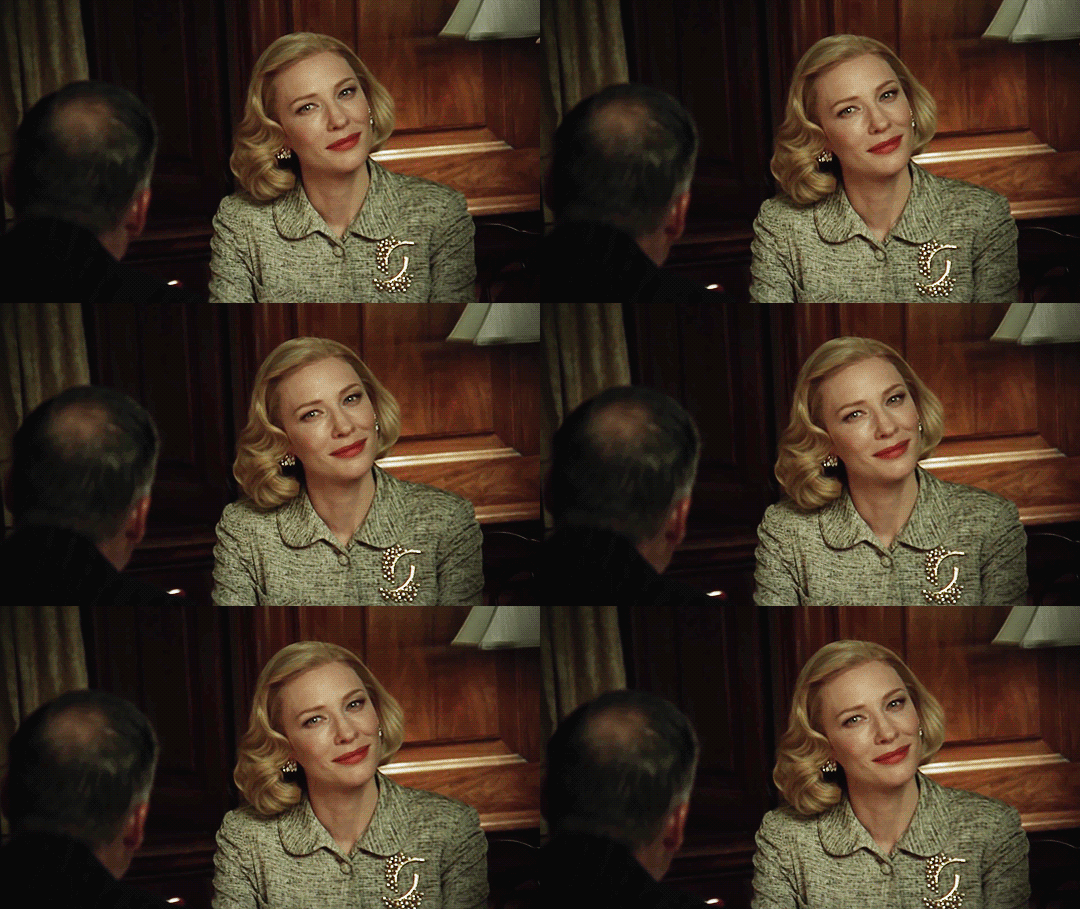
While the power dynamic may have shifted in Therese’s favor, she still feels conflicted by Carol’s departure from their trip and the fact that she loves her nonetheless. At a party with her colleagues, Therese feels disconnected from everyone in attendance, causing her to realize the only place she longs to be is in Carol’s presence and thus decides to go to her. The suspense builds as Therese enters the restaurant, the camera using a point of view shot, thereby transferring the anticipation and nervousness she feels to viewers. In these heart-racing final moments of the film, Therese finds Carol among the crowd, her red smile standing apart from everything else. In this scene, both women are vulnerable yet strong and confident at the same time. Neither of them needs to lean on the other, but they choose to do so anyway as they trust and genuinely care for each other. Red has symbolized each and every emotion felt by both women throughout the film: passion, anger, power, confidence, and love. But perhaps the most significant use of the color comes in the final shot, with Carol’s bright, red lips breaking into a gentle smile. Nothing is said, yet enough is understood, providing a well-deserved resolution to the issues the women previously faced.
Carol exhibits how a film can make bold statements through the proper use of color, glances, and seemingly trivial gestures. The film was sensual and soft, yet still transcending in nature. Since its release, there has not been a lesbian film that has had as substantial of an impact as Carol. It is my sincere hope that more lesbian films are created as “[l]esbianism at the movies means, conversely, an opening up of aesthetic, political, fictional, and psychological horizons that extend traditional narrative boundaries” (Pick 104). This step toward change is not only something the LGBT+ community deeply wants, but one that the mainstream film industry desperately needs.
Works Cited
“Carol (2015) – Last Scene.” YouTube, uploaded by Marcos Silva, 22 Feb. 2016. https://www.youtube.com/watch?v=TXXG0lrrRjM.
Carol. Directed by Todd Haynes. Performances by Cate Blanchett, Rooney Mara, Sarah Paulson, Kyle Chandler, and Jake Lacy. The Weistein Company, 2015.
Davis, Nick. “The Object of Desire: Todd Haynes discusses Carol and the satisfactions of telling women’s stories.” Film Comment, 4 Nov. 2015. Web. 28 Sept. 2018.
Landsbaum, Claire. “Lesbians on the Silver Screen From Desert Hearts to Carol.” Slate.com, 19 Nov. 2015. Web. 28 Sept. 2018.
Pick, Anat. “New Queer Cinema and Lesbian Films.” New Queer Cinema: A Critical Reader, edited by Michele Aaron, Rutgers University Press, 2004, 103-118.
Smelik, Anneke. “Art Cinema and Murderous Lesbians.” New Queer Cinema: A Critical Reader, edited by Michele Aaron, Rutgers University Press, 2004, 68-79.
White, Patricia. “A Lesbian “Carol” for Christmas.” Public Books, 24 Dec. 2015. Web. 28 Sept. 2018.

 Queer Cinema
Great analysis on the color in this movie! I also noticed all the red and it seemed to be a lot brighter than any of the other colors used. I like that it was kept to small things like lipstick and nail polish, keeping with the general subtlety of the film. Though I haven’t seen “Far From Heaven,” I understand that it’s supposed to be more of a melodrama, while “Carol” is more realistic, which explains why the earlier film uses such saturated colors.
LikeLiked by 1 person
I really enjoyed your analysis of the final scene. Throughout much of the movie, Carol seems to be the one in control. She’s older and more experienced, but she never comes off as controlling. I had not thought about how, in the final scene, it is Therese that is suddenly in control. The movie often focuses on Therese’s longing for Carol, but here in the final scene, it is Carol longing for Therese. Carol invites Therese to live with her, but Therese states that she does not think that would be a good idea. She is then pulled away after Carol tells her she loves her and invites her to dinner. This leaves Therese in complete control of the future of their relationship. I was thankful that she ended up choosing to meet Carol at dinner.
LikeLiked by 1 person
Your attention to color is super interesting! I did not even pick up on most of this, especially the progression from muted colors to vibrant colors. Carol was always more bold than Therese was, but it’s neat how Therese incorporates that into her wardrobe too, especially because it’s red. Red symbolizing passion and emotion in other pieces of media definitely tracks in this film too, seeing how prevalent it is in every scene they’re together.
LikeLiked by 1 person