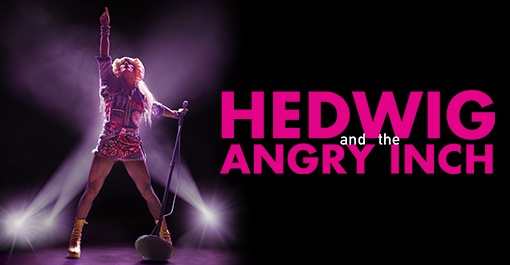
Hedwig and the Angry Inch is a complex film that can be confusing at times but is nevertheless thoroughly entertaining. With often self-deprecating humor that provides comedic relief for its darker scenes, the movie is well-known in the realm of queer film as well as that of musical theatre. Adapted from the 1998 Off-Broadway production, the 2001 film was written and directed by John Cameron Mitchell, who also stars in the film’s title role. Ultimately, the film promotes the notion of self-acceptance, however, it feeds into problematic elements and queer stereotypes to get its message across.
The film follows and is narrated by Hedwig Robinson, a German transgender rock musician, as she recounts her path to stardom in the United States. Born as a boy named Hansel Schmidt in East Berlin, Hedwig longed for a way out of his impoverished life and viewed the U.S. as his opportunity to start over. Amidst this yearning, Hansel meets and falls for an African American G.I. named Luther Robinson (Maurice Dean Wint). In order for them to marry and move to the U.S. together, Luther persuades Hansel to undergo a sex-change operation, thus becoming Hedwig. However, the operation is botched and while Hedwig survives, she is left with a one inch mound of flesh on her crotch, which she later dubs her “angry inch.”
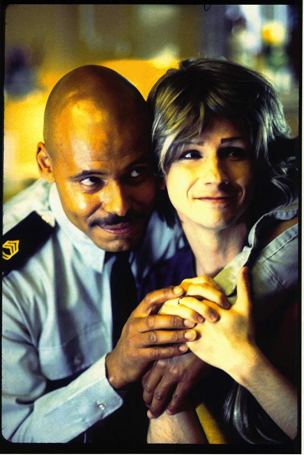
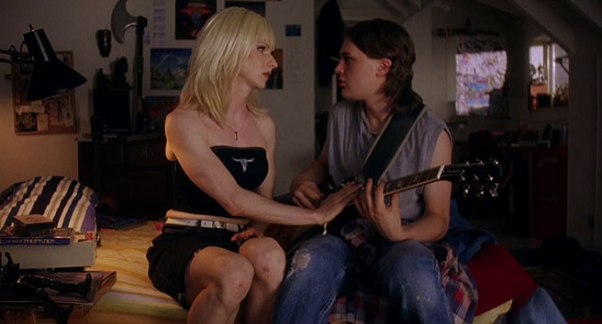
Luther and Hedwig move to a trailer park in Kansas together, but Luther eventually abandons her for a man. While taking multiple jobs in order to support herself, Hedwig meets Tommy Speck (Michael Pitt) while babysitting his younger sibling. She subsequently teaches Tommy all he knows about rock music and he becomes a renowned rock star under the new name of Tommy Gnosis (which was given to him by Hedwig). Tommy’s success emerges when he passes off Hedwig’s songs as his own and leaves her abandoned once again. The film thus becomes Hedwig’s retelling of these events as she and her band, “The Angry Inch” (a reference to her botched operation), follow Tommy’s tour while pursuing a lawsuit against him. They support themselves by playing run-down restaurants with the patrons as their only audience members.
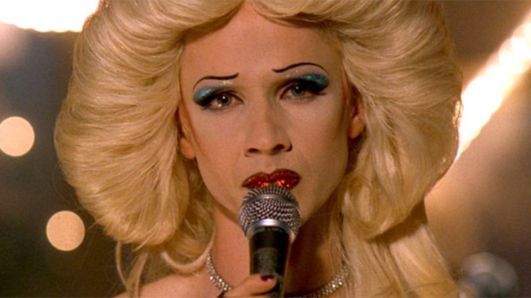
Throughout the film, Hedwig is constantly referencing and even sings an entire song devoted to Aristophanes’ speech in Plato’s Symposium, entitled “The Origin of Love.” The song outlines how humans once had two heads, four legs and arms, and were round. When the gods feared their deviant behavior they decided to split them in two, consequently causing them to spend their whole life longing and searching for their other half. Hedwig states:
It is clear that I must find my other half. But is it a he or a she? What does this person look like? Identical to me? Or somehow complementary? Does my other half have what I don’t? Did he get the looks? The luck? The love? Were we really separated forcibly or did he just run off with the good stuff? Or did I? Will this person embarrass me? What about sex? Is that how we put ourselves back together again? Or can two people actually become one again?
This obsession-like search for her other half exhibits that Hedwig feels a sense of incompleteness within herself. This desperate desire to find her missing link takes up most of Hedwig’s time and efforts and often results in her being taken advantage of. When Hedwig was still Hansel her mother warned her, “To be free, one must give up a part of oneself.” With Luther, Hedwig does this quite literally by agreeing to a sex-change operation. Despite going through with this surgery, it needs to be addressed that “Hansel never expressed a desire for re-embodiment. His desire was for his other half, and for the West” (Jones 462). So determined to find her other half in hopes of becoming whole, Hedwig blindly follows the requests of the people she loves and trusts, regardless of how she actually feels or identifies herself. However, the cycle of abuse began long before Hedwig’s forced procedure.
As a child, Hansel’s father sexually abused him and even though Hansel is 26 when he meets Luther, their encounter still feels predatory on behalf of the latter. Luther baits and seduces Hansel with candy and faulty premises of love, thus earning the title of “Sugar Daddy.” While Luther initially seems to provide for and support her, it becomes clear that in this relationship it is Hedwig that must give more than she takes, especially when she is left in a trailer in Kansas with only her inch and a small amount of money.
It’s shortly after this that Hedwig begins to adopt the destructive tendencies that were employed upon her. Tommy is only 17 when he is introduced to Hedwig, who is almost 30 by this time. After masturbating Tommy (i.e. sexually assaulting him) in the bathtub, Hedwig lures and grooms Tommy in a similar manner to how she was by Luther. She becomes a sort of musical guide for Tommy, educating him on the history of rock music, writing songs together, and even allowing him to play multiple shows with her. In a way, Hedwig creates in Tommy what she never had the chance to be. But when he leaves her after discovering her mound of flesh, taking their songs with him, Hedwig is rejected and left feeling hopeless and helpless.
One character that we hardly get any background on is Yitzhak (Miriam Shor), Hedwig’s husband and bandmate. Since the story is told from Hedwig’s perspective, this lack of attention to her current spouse illustrates how she is much more focused on the people that have hurt her. Hedwig’s preoccupation with them exhibits that she has not gained any closure from the trauma they caused. In these instances, the abused then becomes the abuser as Hedwig displays the same harmful behavior to her partner(s). Due to this, Yitzhak “becomes the target of her misplaced rages against her father, Luther Robinson, and Tommy Gnosis” (Jones 459).
Hedwig is constantly preventing Yitzhak from wearing any of her wigs, restricting him from presenting any gender he wants. The way Hedwig attempts to dictate Yitzhak’s identity is reminiscent of how Luther constructed and altered Hedwig’s gender. Even when Yitzhak tries to escape Hedwig’s control by touring Guam with the musical Rent, Hedwig withholds and then rips up his passport. This scene depicts an instance where “[a]n abusive lover again evokes the passport as a tool to fix an unwilling partner into a coerced identity” (460). Luther convinced Hedwig to have an operation because he made her feel that it was the only means by which she could escape her current situation. By waving Yitzhak’s ticket out in front of him and then destroying it right before his eyes, Hedwig becomes the people that have tricked and mistreated her, those that hid behind the guise of love, only to shatter her hopes and desert her in the process.
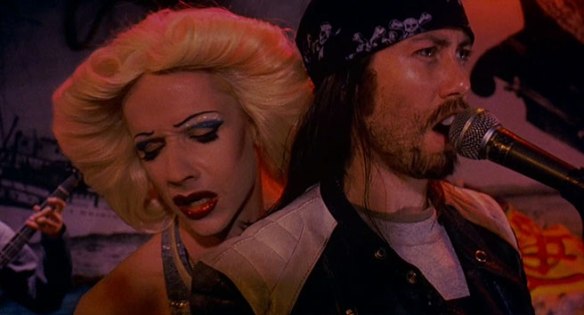
The turning point in Hedwig’s actions only occurs after her band leaves due to her careless behavior and she is reunited with Tommy. After accidentally crashing Tommy’s car, paparazzi flood the scene. Tommy denies their relationship, whereas Hedwig finally receives recognition and her popularity soars while Tommy’s plummets. Back and performing with her band, Hedwig discards her drag, this time only wearing a pair of black leather shorts. In another drastic change of behavior, Hedwig rectifies her previous attitude towards Yitzhak, dancing with him for the first time and offering him her coveted wig. Rather than continue to exercise unnecessary control over him, Hedwig instead enacts a gesture that “signifies that Hedwig finally allows Yitzhak to cross-dress, an act that the latter has longed to do” (Hsu 113). Relinquishing her hold over Yitzhak not only insinuates that Hedwig has gained closure with her own trauma, but exhibits that she has broken the cycle of abuse that was imposed upon her so early in life. By ending this cycle, Hedwig becomes more free than she has ever been, as the film’s closing scene shows Hedwig walking down a dark alley completely naked. While she never technically finds her identical or complementary other half in a person, at the conclusion of the film Hedwig is whole nonetheless, finally acknowledging that her other half exists within herself.
Despite its multitude of problematic elements and queer stereotypes surrounding transgender people in particular, Hedwig and the Angry Inch puts forth important notions regarding identity and behavior. After her final encounter with Tommy, Hedwig learns that she did not need to attempt and create her other half in someone else, nor did she need to find her other half to be whole. In fact, the film is more so about Hedwig’s “obstacle filled journey from borderline self-loathing to true self-acceptance” (Hart 61). The theme of self-love and acceptance is crucial as it speaks to a broad range of audiences, however, I feel the film could still have portrayed this message without insinuating that LGBT+ people are manipulative predators. With this being said, the film proves that a person is not defined by the traumatic events they have faced, nor do they have to be become the people that hurt them.
Works Cited
Hart, Kylo-Patrick R. “The Incredibly Queer Adventures of Hedwig and the Angry Inch.” Presentations of the 29th Annual SW/Texas Regional Meeting of the Popular Culture and American Culture Association: Gender, edited by Gypsey Elaine Teague, Cambridge Scholars Publishing, 2009, 57-64.
Hedwig and the Angry Inch. Directed by John Cameron Mitchell. Performances by John Cameron Mitchell, Michael Pitt, Miriam Shor, and Andrea Martin. New Line Cinema, 2001.
“Hedwig and the Angry Inch – Origin of Love.” dailymotion, https://www.dailymotion.com/video/x57grk. Accessed 6 Oct. 2018.
Hsu, Wendy. “Reading and Queering Plato in Hedwig and the Angry Inch.” Queer Popular Culture: Literature, Media, Film, and Television, edited by Thomas Peele, Palgrave Macmillion, 2011, 103-117.
Jones, Jordy. “Gender Without Genitals: Hedwig’s Six Inches.” The Transgender Studies Reader, edited by Susan Stryker and Stephen Whittle, Routledge, 2006, 449-467.

 Queer Cinema
Good analysis of the themes of abuse in this movie. I also noticed that Hedwig became an abuser and predator in the mold of Luther, but I felt that the movie never really addressed it. Tommy and Hedwig’s relationship was portrayed as a tragic romance rather than the result of the cycle of abuse. I also wish the movie could have incorporated more of Yitzhak’s backstory. The original musical gives a lot more information on him, and apparently some scenes with him were cut from the film. But it does serve to reflect Hedwig’s self-involvement.
LikeLiked by 1 person
I absolutely agree with your thoughts on the way in which the message of this movie is presented. Overall, it expresses that idea of self-love and self-actualization, but it uses gross tropes and stereotypes in the process. I agree that it could have been just as effective without all the predatory behavior and pedophilia, no matter how much trauma a character has experienced.
LikeLiked by 1 person
I enjoyed reading you analysis of Hedwig and the Angry Inch. You did a good job of touching on theme of the abuse cycle and self discovery in the film while using stereotypes to do it. All your examples and evidence make it clear that this is something that is prevalent through the film. But since we are so focused on trying to figure out what is going on with Hedwig, we tend to put the abuse seen throughout the film on the back burner.
LikeLike