More often than not, the quality of a film is discerned by the amount of nominations and awards it receives. In 2005, when Brokeback Mountain was released, audiences labelled it ‘ground-breaking’ as, up until that point, mainstream cinema had not produced a blockbuster film that was centered around a gay relationship. In 2017, with the premiere of Call Me By Your Name, similar praise was given to the film as viewers flocked to theaters and left sobbing, as was the case with its predecessor. Both of these movies won multiple awards and received much critical acclaim because mainstream audiences felt as though they were seeing an accurate depiction of a relationship involving two men. However, these viewers do not take into account that these films are high budget, feature big name, well-known actors, and unfortunately give way to the countless stereotypes surrounding gay men.
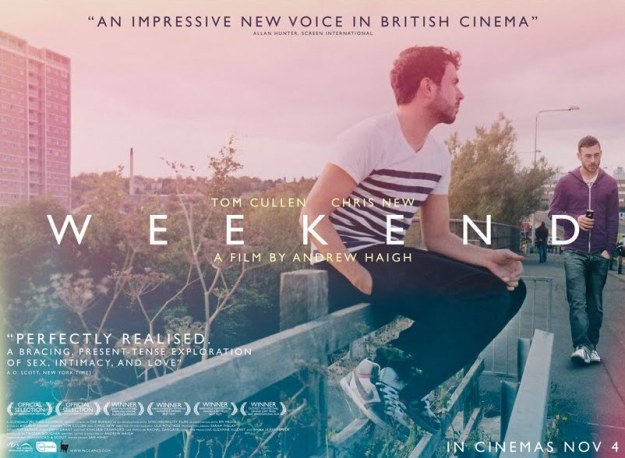
The British film Weekend is similar in the sense that it was popular and highly praised upon its release in 2011. It differed in its attempt to stray from the secrecy, predatory nature, and self-loathing aspects that usually plague this specific genre. While it is not entirely free of problematic elements–still giving way to tropes that are often used when depicting white, gay males–it puts forth a more authentic portrayal of a gay relationship. Therefore, it is quite disheartening that this film is slowly beginning to fade from public memory, while the other two movies have been able to hang on.

Weekend details the brief relationship between Russell (Tom Cullen) and Glen (Chris New) as they have a one-night stand after meeting at a gay club toward the start of the movie. The rest of the film follows their ensuing relationship over the next 48 hours, as Glen is about to embark on a two-year stay in the United States. Their encounter differs from a typical hook-up wherein the next morning Glen pulls out a tape recorder and asks Russell to recount intimate details about the previous night. Embarrassed, but nonetheless intrigued, Russell cooperates. Glen later reveals that these tapes are going to be used as part of his next art project about the personas people take on when hooking up with someone new as he believes these experiences show the gap between who people truly are versus who they want to be. The two men end up spending much of the next two days together, sharing personal details, stories, and emotions prior to Glen’s inevitable departure. The film displays a more realistic relationship, or at least the possibility of one, but it does so in a much different manner than other films within its genre.
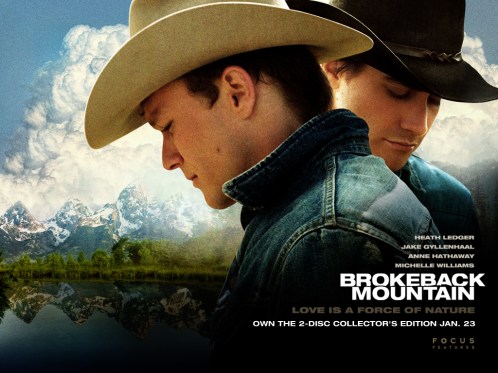
Brokeback Mountain illustrates the relationship that takes place between Ennis Del Mar (Heath Ledger) and Jack Twist (Jake Gyllenhaal) after they work together herding sheep in Wyoming one summer. Their intense relationship ends when summer does, but their feelings remain intact as they try to secretly carry on their relationship over roughly the next 20 years.
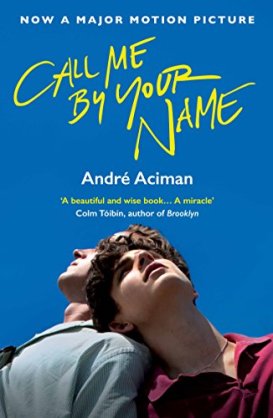
Call Me By Your Name details the relationship that develops between 17-year-old Elio (Timothée Chalamet) and his father’s 24-year-old research assistant, Oliver (Armie Hammer), when he lives with them for a summer in northern Italy. While the two initially seem to dislike each other, they eventually spend more time together and their relationship turns romantic. Like Brokeback Mountain, Elio and Oliver feel the need to hide their relationship from everyone around them.
Many find it difficult to watch Weekend in its entirety not because of the content but perhaps because of the lack thereof. The film has a slow start, and hardly progresses from there. Much of the movie consists of simple scenes filled only with dialogue, as most of the film takes place at Russell’s flat with just he and Glen present. Whereas films like Brokeback Mountain and Call Me By Your Name employ mountainous views or shots of the Italian countryside, Weekend removes these outside factors to strip down the scenes to just that of the conversations between the two men. The movie rarely uses music, typically only utilizing it if the characters are the ones listening to it. This can make the film appear lackluster or monotonous, but it does so to give an honest portrayal of a budding relationship.
Due to the components that appear to be missing, the film adopts an almost documentary feel, with many of the conversations coming off as quite candid. This authenticity was likely a goal put forth by the production team as many of the scenes were improvised during filming. The dialogue therefore felt honest because, in a way, it was since a set script was not always followed. Specific shots and angles also contribute to the realistic nature of the film. In many of the scenes where they are in public, Russell and Glen are viewed almost as if the camera is across the room from them, listening in on their conversation. The product of this technique is that the two men are viewed clearly while the other people around them as well as the setting are out of focus. This gives viewers an “outside looking in” perspective that makes them feel as though they are peering into private conversations that occur while a relationship is beginning to unfold. Thus, even though the film follows a fictional story line, it nevertheless embodies the true nature of the start of a new romance.

Whether people want to admit it or not, Brokeback Mountain and Call Me By Your Name include events and scenes that, for the most part, can be classified as fantasy. The couple in Weekend, on the other hand, meet at a club, which is where many people, regardless of sexuality, go to meet potential partners. The other two films also grant their characters several decades or, at the very least, an entire summer to develop their relationship. In Weekend, Russell and Glen are only given a 48 hour period. Despite having to pack their encounters into an hour and a half window, the film still presents the developments that occur as their relationship progresses. For instance, when he is leaving on the morning following their initial hook-up, Glen shakes Russell’s hand, almost as if he is completing a business transaction. However, the next time he leaves Russell’s flat, Glen leans in and kisses him. It is a subtle change, but nonetheless important to note in terms of development.
The film does not attempt to draw in audiences with grand gestures or quotable lines like standard, straight dramas, but instead does so by presenting genuine conversations in all their intimacy and awkwardness. Moreover, the movie captures the fine line people walk when beginning a new relationship–wanting to be with the other person, yet not wanting their feelings to be one-sided or to come off too strong for fear of scaring the other person away. While other films that deal with romance rely heavily on outlandish acts that are not typical in day-to-day life, Weekend opts for a more conventional approach when given the opportunity. If given a similar situation to Russell and Glen’s, an overly-dramatic film would have included Glen miraculously locating Russell’s birth parents to give him a “proper” coming out experience. Weekend provides a more realistic, yet just as affectionate response. Glen suggests Russell pretend that he is his father as a way to give him a sort of artificial coming out experience. While he is reluctant at first, Russell agrees and when he’s finished Glen, still pretending to be Russell’s father, tells him how proud he is of him. This not only gives Russell a coming-out moment of his own, but Glen makes it a positive and supportive one, which is unfortunately not the case for many.

With all this being said, Weekend is not the exact opposite of Brokeback Mountain and Call Me By Your Name as all three films share many of the same themes and ideas. The people involved in each relationship know that their time is limited and if not at the film’s center, each movie at least includes aspects of internalized homophobia. While Russell and Glen do not necessarily feel the need to hide their relationship in the same way that Ennis and Jack or Elio and Oliver do, they also are not completely outright and open with it. However, Russell and Glen’s relationship is not nearly as unhealthy nor predatory as the ones shown in Brokeback Mountain and Call Me By Your Name, as the other films either display violent behavior or a gross age gap.
While Weekend still presents some stereotypes and problematic elements, it does provide a more honest version of a gay relationship than Brokeback Mountain and Call Me By Your Name. Although, despite it being a better option than mainstream films about similar subjects, it is unfortunately falling off the radar. Instead, films like Brokeback Mountain or Call Me By Your Name are often referenced in regards to gay relationships. Weekend likely gets dismissed for its lack of action, yet by taking this different approach, it is much more relatable and authentic in comparison with the other two films. It is clear that the movie industry has a long way to go in terms of creating films that depict completely honest, and healthy gay relationships. While Weekend is a step in the right direction when it comes to queer films, the gay community deserves better than what they have been given.
Works Cited
Brokeback Mountain. Directed by Ang Lee. Performances by Heath Ledger, Jake Gyllenhaal, Anne Hathaway, and Michelle Williams. Focus Features, 2005.
Call Me By Your Name. Directed by Luca Guadagnino. Performances by Armie Hammer, Timothée Chalamet, Michael Stuhlbarg, and Amira Casar. Sony Pictures Classics, 2017.
Weekend. Directed by Andrew Haigh. Performances by Tom Cullen, Chris New. Sundance Selects, 2011.

 Queer Cinema
I like that you compared all three films. Call Me By Your Name is the only one I haven’t seen, but I know all three of them are pretty similar across the board, and they paint a clear picture of what most mainstream queer cinema is like. Weekend is an okay movie in general, but as a queer film, I appreciated its realism more than the Oscar-bait tragedy of Brokeback Mountain. At least Weekend tried to start an honest conversation about gay representation.
LikeLiked by 1 person
I really enjoyed your comparisons amongst the three! CMBYN and Brokeback do present a lot of less realistic expectations within relationships, whereas Weekend really offered a lot more honest substance. I think that certainly mainstream audiences are looking for astounding views and lovely scenery, but I also believe authenticity to be equally as important. Weekend offered something the others could not, but like you said, I think there is still some tropes that are fed into during the movie. Thanks for sharing!
LikeLiked by 1 person
Although I was unable to watch the other films, you made it very easy to compare when reading your journal. I liked how you mentioned how the realistic elements of queer lives differed between films. They both have their toxic tropes that they must feed into, but they also both give us somewhat of a reality.
LikeLike
I like that you included emphasis on how awkward Weekend could be at times. I agree, it really does add to the realism and genuineness of the film. Real life conversations don’t go as smoothly as a movie script. I think a lot of this has to do with the fact that a lot of these scenes were a lot of improvisation, leaving room for real and genuine reactions. Being more realistic doesn’t make it better though, I agree, especially with the themes of internalized homophobia prevalent throughout.
LikeLike
I really liked your thoughts on Brokeback Mountain and Call Me By Your Name being fantasy. They do seem fantastical, along with many romance movies in Hollywood. There’s a disconnect between real romances and what movies try to pander as real. Weekend has a more realistic approach to conversations, with pauses and restarting and awkward answers. I appreciated that you added that the movie industry has a long way to go in gay movies.
LikeLike