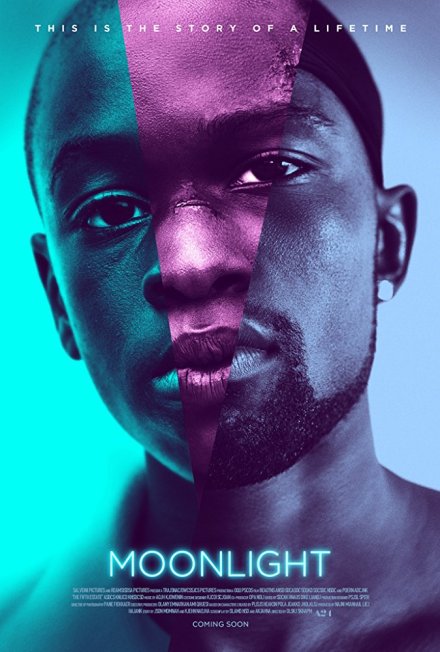
Performing a certain gender can be difficult waters to navigate. For black men, the task becomes all the more troublesome as they not only have to assert their masculinity, but they often feel forced to defend their blackness as well. This situation is contradictory as “the rules that govern adjudication of these performances shift in different contexts among different groups” (Young 4). Furthermore, these presentations do not remain constant because “an exceptional performance in one site is an unacceptable performance in another site” (4). Thus, black men often struggle with conforming to society’s standards since they are always changing. This, of course, leaves little to no room for these men to be their authentic selves. The 2016 film Moonlight depicts a black man as he grapples with these impossible standards all while attempting to discover his own identity. In more ways than one, the film is a breath of fresh air in that it reverses a multitude of stereotypes surrounding black male relationships as well as redefining what being both black and gay entails in terms of gender performativity.
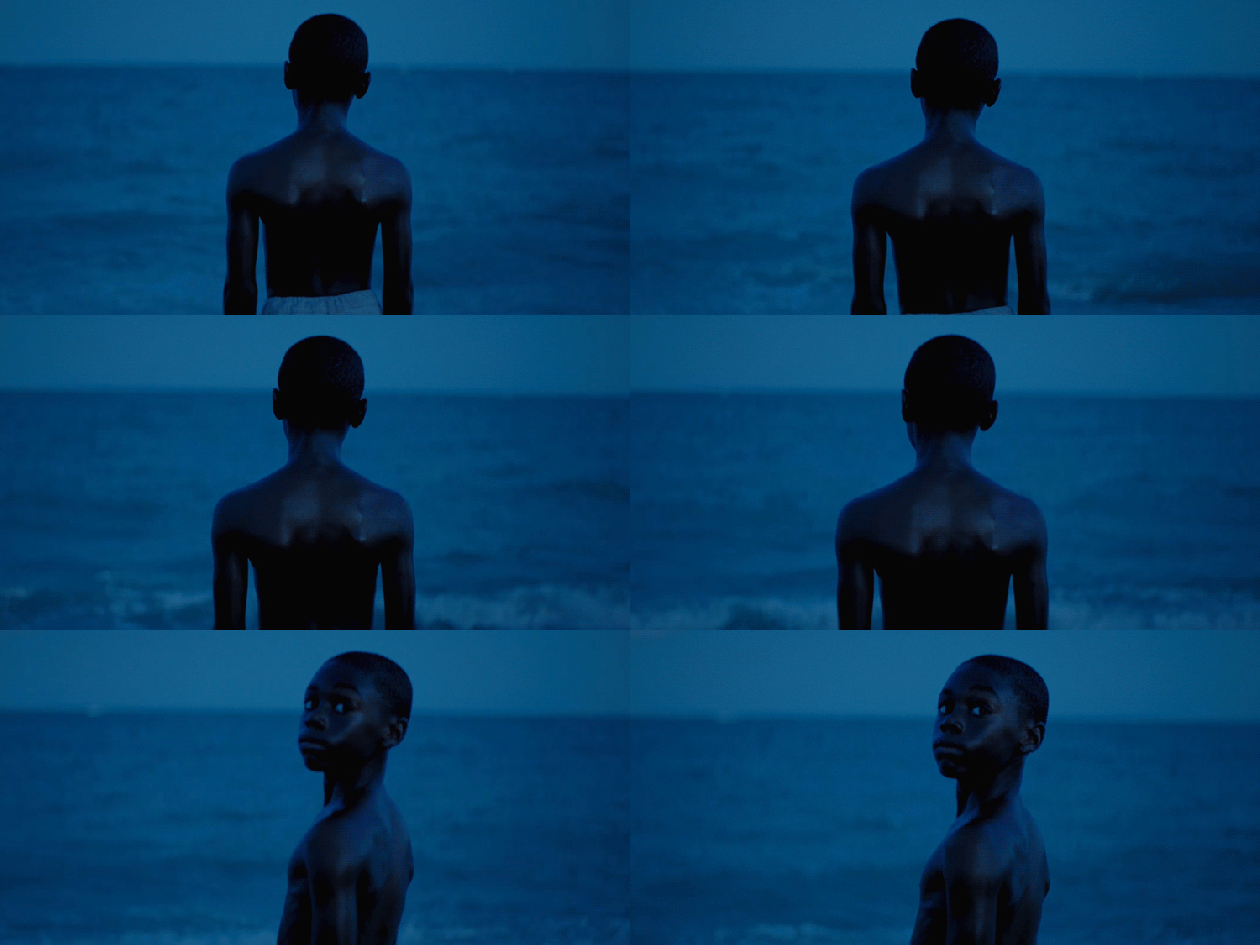
Barry Jenkins’ film Moonlight is based on Tarell Alvin McCraney’s unproduced play In Moonlight Black Boys Look Blue. The movie takes the form of a triptych, with its poster literally reflecting this type of work with three separate images combined to form one. The film presents three periods that are connected and therefore meant to be appreciated together. Set in Miami, Moonlight follows a young black man named Chiron through three stages of his life–childhood, adolescence, and young adulthood–each titled “Little,” “Chiron,” and “Black” respectively. The film is sort of fragmented as the stages end on pivotal moments in Chiron’s life, with the next chapter picking up after a substantial amount of time has passed.
Throughout his life, Chiron deals with a myriad of issues, whether it be his neglectful and drug abusing mother, homophobic neighborhood bullies, or struggling to define his own masculinity. Chiron must adapt to fit into various spaces as much of his motivation to do so is hinged on survival. Perhaps the main focus of the film is centered around Chiron’s ever-changing relationship with Kevin, whom he has known since childhood. During adolescence, the two become intimate, but both boys still wrestle with how to present themselves for fear of being labelled and/or targeted if they do so in an unaccepted manner.
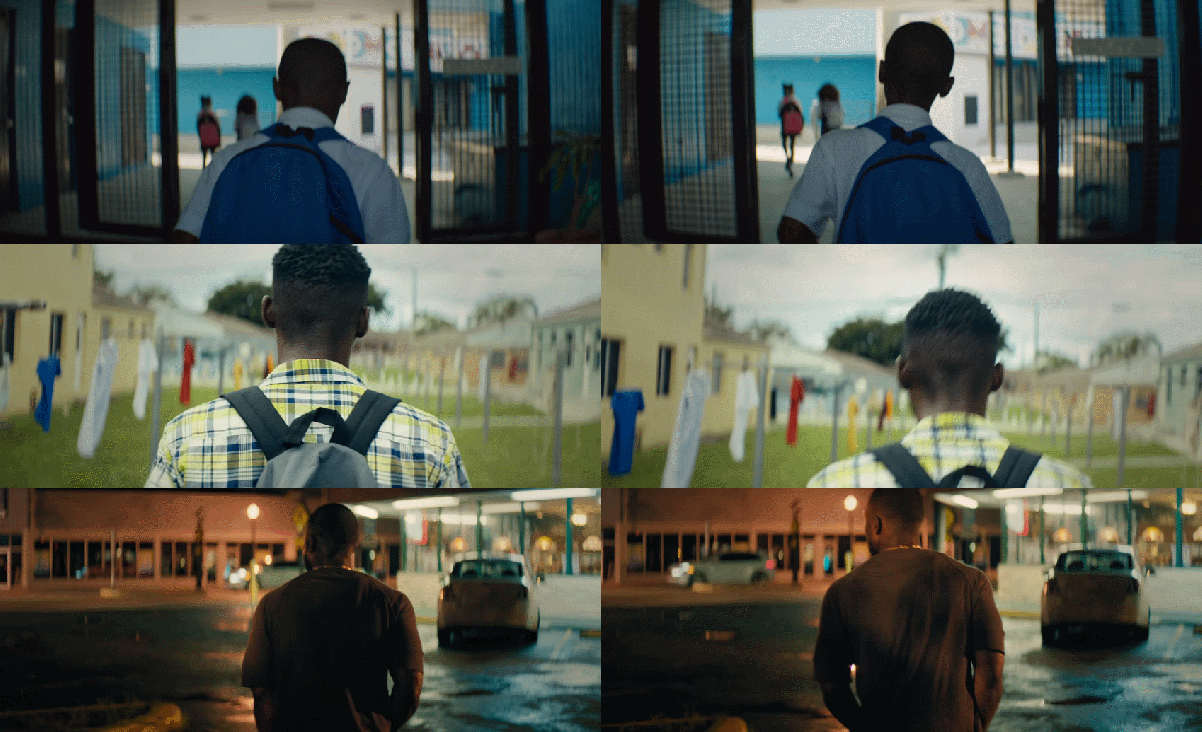
Moonlight is a difficult film to concisely summarize because it encapsulates more than just a relationship or a man’s journey through life. While it does includes both of these components, the film adds multiple layers to each scene, often to the point where audiences cannot possibly catch every subtlety in merely one viewing.
The entire movie was excellently executed, from the plot to the casting to the cinematography and score. It is no wonder, at least to me, that the movie was not only nominated, but won the Oscar for Best Picture at the 2017 Academy Awards. While the honor was obviously well-deserved, even in the midst of what should have been an immensely celebrated and monumental win, the Moonlight cast and crew were still sort of snubbed by the mistake during the award presentation. There was a mix-up with the results card, causing audiences to believe La La Land had won Best Picture, when Moonlight actually received the award. The film was thus still robbed as more people were discussing the mix-up itself rather than the film or the fact that it was the first film with an all-black cast and the first LGBTQ+ film to win Best Picture.
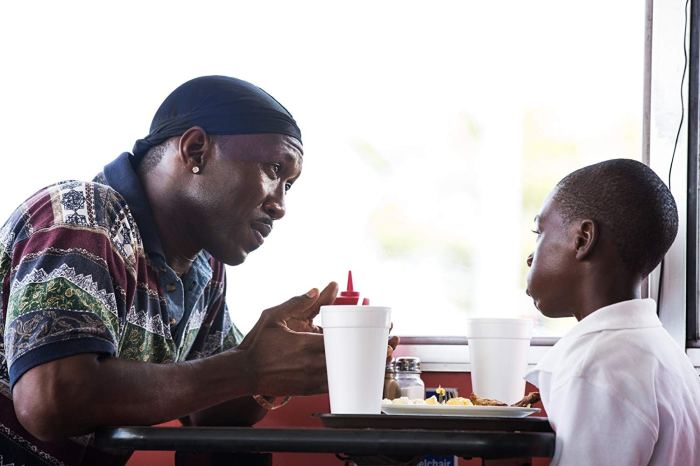
While it is not the main relationship within the film, the bond shared between young Chiron (Alex Hibbert) and Juan (Mahershala Ali) is an important one nonetheless. Juan becomes a father figure to Chiron as his biological one is absent. Although Juan is a drug dealer, his character is crafted so carefully that it alters the perception that most viewers are so used to seeing on screen. As theatre director, Kimahli Powell notes, “We’ve seen the black drug dealer so many times [but] I can’t recall a portrayal with so much sensitivity” (Parris). With Chiron, Juan is patient and compassionate, which is unfortunately a relationship that is not commonly depicted in mainstream films about black men. Juan and his girlfriend Teresa (Janelle Monáe) provide a supportive environment for Chiron, where one of the house rules is “all love and all pride” (Moonlight).
One of the most heart-warming and compelling scenes comes when Juan takes Chiron swimming for the first time. Since Chiron does not know how to swim, Juan teaches him, holding him up in the water at first. He reassures Chiron that he will not let anything bad happen to him, saying “Whatever happens. I got you” (Moonlight). While many audiences likely felt a sense of apprehension at the introduction of this relationship, I never once found myself frightened or worried that it would soon take a turn for the worse. All too often, black relationships involving an adult and a child are made out to be manipulative or predatory, but this one was different. Despite Juan’s job and the possibility for disaster, there was something in the portrayal of his character that made me feel that I could genuinely believe in his words and actions. Writer David Lewis-Peart initially felt some of this unease as he notes: “I realized that the feeling of patiently waiting to be disappointed was exactly what Chiron was struggling with up until that scene. Can I trust this man? I was genuinely moved as I realized he, and I, could” (Parris). This scene proves that a relationship does not necessarily have to be romantic to be a meaningful one that resonates with viewers.
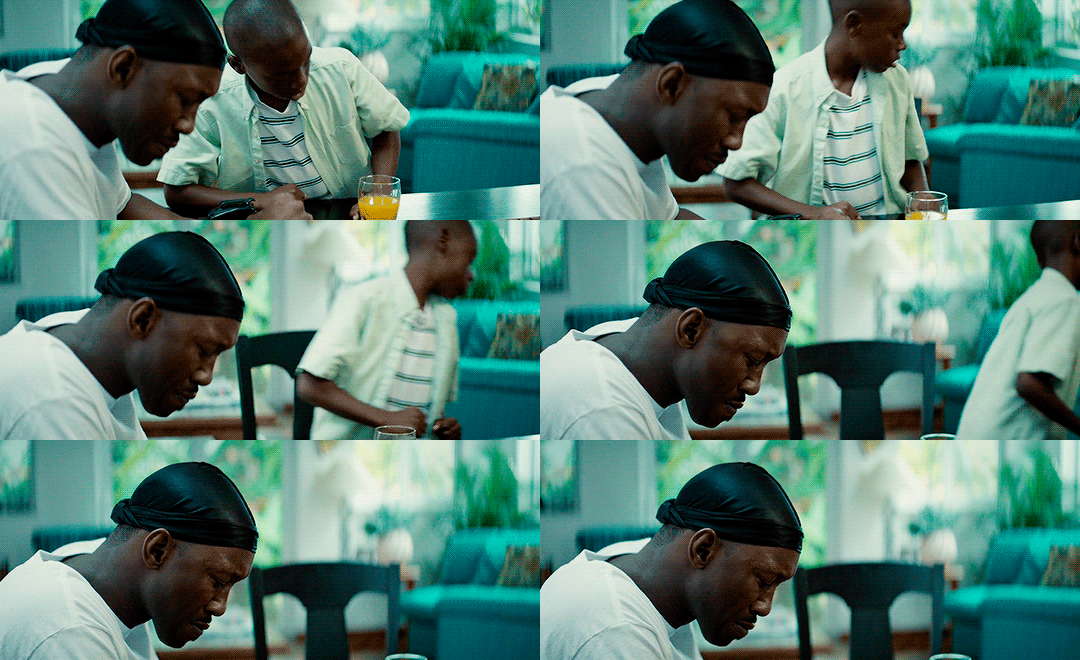
This, however, makes it all the more heartbreaking when Chiron discovers not only that his mother is doing drugs, but that it is Juan who is selling them to her. Chiron has just finished asking Juan what the term “faggot” means. Juan responds and continues to tell Chiron that it’s okay to be gay, as he has always preached to him about how he must decide for himself who he is going to be and that he cannot let anyone else make that decision for him. Shortly thereafter, Chiron puts two and two together as he sees that his mother’s drug addiction and Juan’s job as a drug dealer can only mean one thing. Chiron’s place of refuge is destroyed as he realizes that Juan, who has up until now been a source of protection and acceptance, is simultaneously the root of Chiron’s pain. The image of Chiron getting up and leaving after his fears are confirmed and Juan sitting with his head down, conflicted, is not only an image that stays inside a viewer’s mind, but the one that ends the section of the film titled “Little.”
From a young age, Chiron learns that he must act both black and masculine enough or face harsh judgement from his peers. Following Juan’s death, as Chiron enters his teenage years, he is almost completely on his own as he no longer has that model for masculinity that Juan once fulfilled. The only other example of manliness Chiron has aside from Juan is Kevin, whose black masculine performance has always come easy, or at least appeared to. When they are children, Kevin (Jaden Piner) tells Chiron that he has to show the other boys that he “ain’t soft.” When they are teenagers, it becomes Kevin (Jharrel Jerome) that feels pressured into proving his masculinity when Terrel (Patrick Decile) dares him to beat up whoever he picks out, his obvious choice–Chiron (Ashton Sanders).
Chiron, however, does not stay down after the first punch from Kevin but stands up, staring into the eyes of both his attacker and the boy whom he deeply cares for. Kevin almost begs Chiron to stay down, completely contradicting the lesson he taught them when they were children. In this instance, both characters are trying to prove they are not weak, which makes for a disastrous combination. The following day, Chiron attacks Terrel with a wooden chair and is subsequently arrested by police, staring at Kevin as he is escorted to the cruiser, thus ending the second section of the film.
As an adult, Chiron (Trevante Rhodes) is completely transformed from his younger self. However, this stage of Chiron’s life can be viewed in several different ways. Some may believe that he is exhibiting hyper-masculinity, while others may argue that this is who he truly is. A third possibility for his persona is that he is emulating the only male role model and father figure he had while growing up–Juan. Chiron has become a drug dealer in Atlanta, Georgia and is no longer scrawny, but muscular and dons a grill, all of which are reminiscent of Juan.
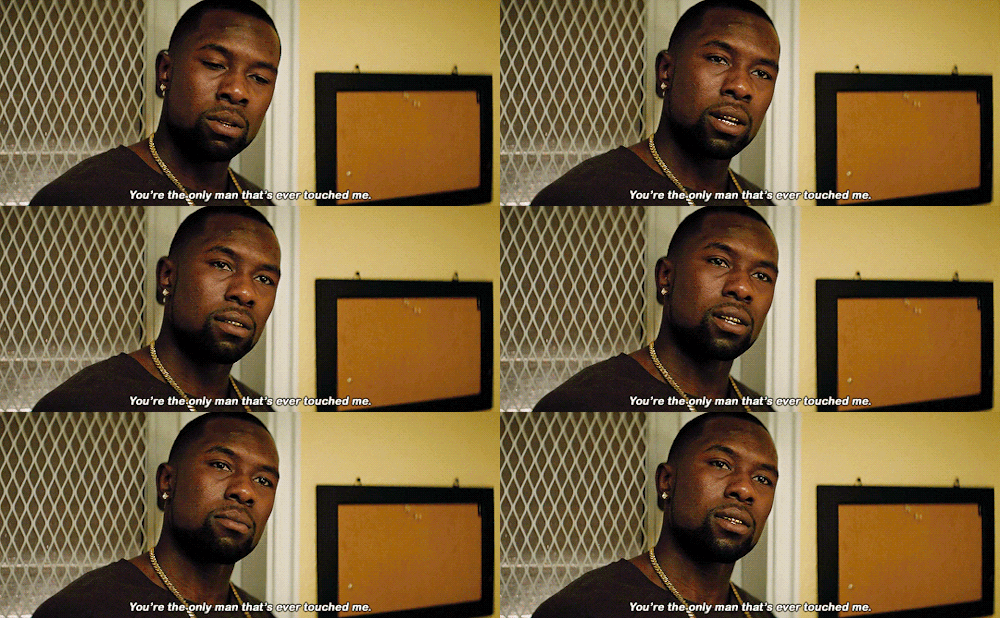
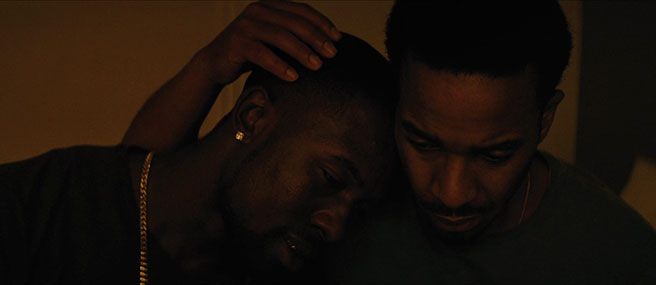
Although, his reserved nature remains, and at this point in his life it adds to his masculine performance. He reconnects with Kevin (André Holland) in Miami who, even after all these years, is still able to break through Chiron’s presentation. Later at Kevin’s house that night, Chiron reveals that Kevin is the only man he has ever been with. The film concludes shortly after this confession, with one of the final images being Kevin affectionately holding Chiron, allowing both men to be themselves in that moment.
Moonlight is unlike any other film I have seen before. It adequately and accurately displays men that have always been token characters if they were not omitted from films altogether. Furthermore, it captures the complexity of these characters in a way that allows the film to resonate with audiences, even if they cannot directly relate to the experiences being portrayed on screen. The film is not only one of the most beautifully crafted films to exist, but it is significant and relevant, as representation does matter. Moreover, Moonlight has worked to pave the way for other stories–ones that have often been pushed aside or silenced–to emerge at last.
Works Cited
Moonlight. Directed by Barry Jenkins. Performances by Trevante Rhodes, André Holland, Janelle Monáe, Ashton Sanders, Jharrel Jerome, and Mahershala Ali. A24, 2016.
Parris, Amanda. “Masculinity and ‘Moonlight’: Eight black men dissect Barry Jenkins’ momentous film.” CBC Arts, 4 Nov. 2016. https://www.cbc.ca/arts/masculinity-and-moonlight-eight-black-men-dissect-barry-jenkins-momentous-film-1.3836460. Accessed 17 Nov. 2018.
Young, Vershawn A. “Compulsory Homosexuality and Black Masculine Performance.” Sexing the Colorlines: Black Sexualities, Popular Culture, and Cultural Production. vol. 7, no. 2, 2011, 2-20.

 Queer Cinema
Your analysis is wonderful! This film is so complex and beautiful, both visually and thematically. There’s so much to enjoy here. I love your final paragraph where you talk about the film’s significance and how it can be resonant even if the viewer can’t completely relate. Hollywood assumes that only cishet, white, male stories are worth telling. They don’t think mainstream viewers want to watch movies about people of color or queer people. But Moonlight definitely proves that notion wrong. Art is art, no matter who it’s about.
LikeLiked by 1 person
I appreciate your analysis on the complexity of characters, especially. I feel like too often we see characters that are subject to stereotypes, especially black or queer characters. The fact that this film acknowledges that these characters are, you know, people, is one step closer to more accurate and satisfying representation in media. It opens up these formerly secret and (as you said) silenced worlds to a more mainstream audience.
LikeLiked by 1 person
I think this movie really does a fantastic job of showing the delicate nature of being vulnerable. I really enjoyed your discussion about Kevin breaking through to Chiron. Kevin and Chiron permitted themselves to be vulnerable, and they were rewarded in the end for it. Vulnerability is very scary for anyone, and I think the movie did a great job of displaying those exact feelings.
LikeLiked by 1 person