
For queer people, the act of coming out can be an utterly terrifying endeavor. For someone in high school, with the pressure of preparing for their future weighing on them, the task becomes all the more daunting. Even if one has a stable support system, the choice can still be scary as they do not want to alter certain relationships as a result. The 2018 film Love, Simon deals with this precise dilemma. The main character is a teenager that is struggling with the decision to come out to his friends and family. As a whole, the film not only looks into the act of coming out, but challenges the notion entirely.
Based on Becky Albertalli’s 2015 young adult novel, Simon vs. the Homo Sapiens Agenda, the film follows Simon (Nick Robinson), who is a 17-year-old that has not told anyone that he is gay. Simon has a solid group of friends and a loving family, however, he is still afraid to come out to them. After reading a post from another closeted gay kid on his school’s gossip blog, Simon begins forming a connection and building a relationship with this person who is only known as “Blue” using his own pseudonym–“Jacques.” However, this relationship and Simon’s secret are jeopardized when one of his classmates, Martin (Logan Miller), discovers this correspondence and decides to blackmail Simon. Martin uses this information against Simon to get closer to Abby (Alexandra Shipp), threatening to out Simon if he does not help him. The film continues with Simon reluctantly helping Martin all while trying to figure out who Blue is in the process. 
Despite his supportive friends and family, Simon still fears coming out for multiple reasons. First and foremost, Simon worries he will be rejected upon coming out. He sees the way Ethan (Clark Moore), his openly gay classmate, gets harassed and teased at school for his sexuality. The words and phrases these bullies use influence others’ behavior, which goes into the concept of “terministic screens” and how they operate. Essentially, these screens act as a sort of filter as “much that we take as observations about “reality” may be but the spinning out of possibilities implicit in our particular choice of terms” (Burke 46). Both the bullies and a majority of the school are simply ignorant and uneducated about queer identities, therefore, when a derogatory term or stereotype is presented, they all adopt a homophobic mentality. As a result of this, Simon is afraid of coming out because he believes he will be subject to the same kind of ridicule, and he is not completely wrong in these assumptions as he is mocked after being outed.
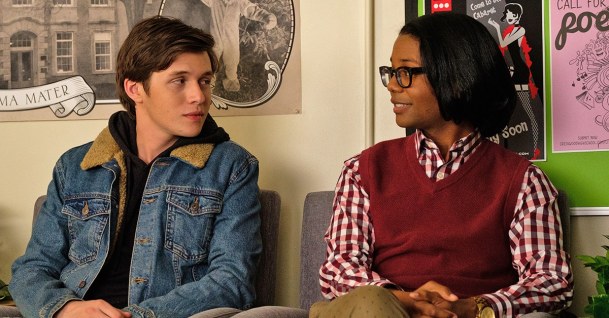
Whereas with most films, audiences do not get to hear a character’s inner thoughts and monologue as they would with a book, the way Simon communicates with and relates to Blue gives viewers this insight into his feelings regarding coming out. Aside from his fear of rejection, Simon tells Blue how he wants things to stay the same as he is not ready for his entire world to change just yet. He does not want his friends and family to view him differently because, as he also tells Blue, he likes the way his life is now.
The way Simon is attempting to sort out his emotions gets disrupted when Martin blackmails him. Initially and apprehensively, Simon agrees to help Martin become closer with his friend Abby. However, this situation becomes complicated when Simon has to lie to both of his other friends, Leah (Katherine Langford) and Nick (Jorge Lendeborg Jr.). Nick and Abby have mutual feelings for one another, but Simon tells Nick that Abby has an older, more experienced college boyfriend. He then pushes Nick to go out with Leah, who he believes is in love with Nick when Leah actually has feelings for Simon, unaware that he is gay. While these actions are harmful to his friends, they can be justified in a sense as Simon lies in order to protect his own secret.
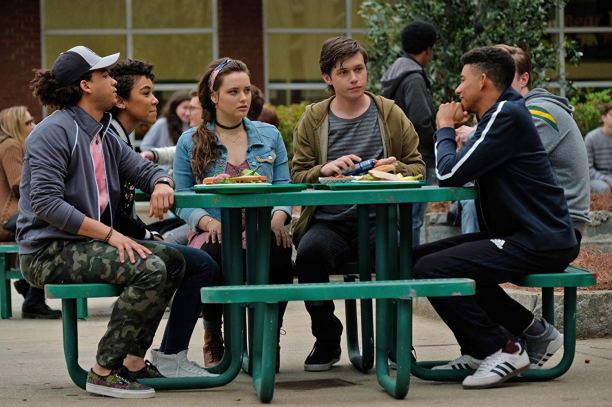
Simon is constantly trying to piece together who Blue may be, using context clues from their emails in an attempt to identify him at school. At first, Simon thinks Blue is Bram (Keiynan Lonsdale), one of Nick’s soccer teammates, but he rules this possibility out after he discovers him making out with a girl at a party. Following this, Simon believes Blue could be Lyle (Joey Pollari), a Waffle House waiter and classmate of his. Although, he abandons this assumption when Lyle asks Simon if he is romantically involved with Abby because he is interested in her. Upset that he keeps striking out when it comes to finding Blue, Simon shrugs off Martin when he asks for advice on his latest plan to win Abby over. This results in Martin being rejected by Abby at a football game in front of the entire school.
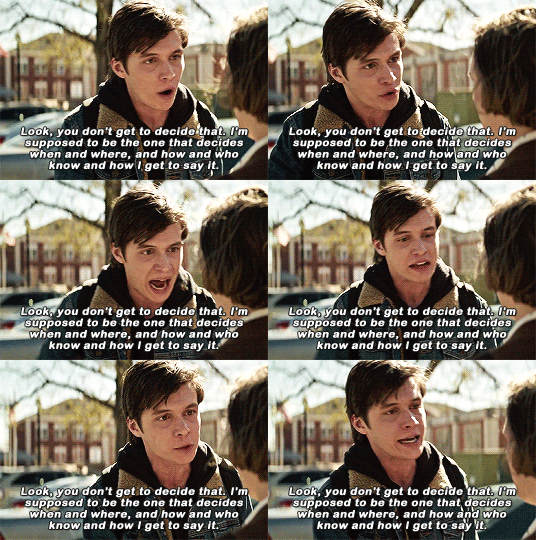
A flood of posts making fun of Martin appear on the school’s gossip blog. Humiliated and desperately wanting the attention off of himself, Martin posts Simon’s emails, thus outing him to anyone that reads the blog. Knowing that Blue wanted to remain anonymous, Simon is terrified that he will lose him altogether. Along with this, Martin has taken away a decision that was meant to be solely Simon’s. Coming out is a personal choice that should be left up to that specific person and no one else, which Simon addresses when Martin tries to apologize. While the situation could have been much worse for Simon–as after the post is uploaded, his phone is inundated with positive and supportive messages rather than offensive and hateful ones–the fact that Martin took away something that is meant to be an intimate and private decision is inexcusable.
Since they are likely not even aware that the school blog exists, Simon gets more autonomy with coming out to his parents. The fear remains due to the fact that Simon’s father (Josh Duhamel) has made homophobic remarks the entire film, at one point calling a male contestant on The Bachelor “fruity.” Even after Simon comes out, his father immediately asks, “Which girlfriend turned you?” trying to make a joke out of the entire situation. His mother (Jennifer Garner) stays almost silent the whole time, seeming to ruminate on the news.
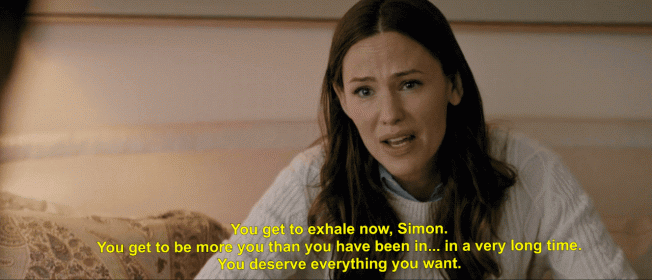
Overall, Simon’s parents actually set a positive example for all parents when addressing their child who has just come out. When given the opportunity to talk one-on-one, Simon’s mother emotionally tells him that he is still him, dispelling his long held belief that his life would be changed by coming out. She equates him hiding his sexuality to holding one’s breath, reassuring him that he can finally exhale. She goes on to tell him that he will not be viewed differently, but rather that he will now get to be more him than he has ever been before.
The conversation Simon subsequently has with his father is all the more touching. His father does not ignore his previous comments, but instead acknowledges them and apologizes for the years of jokes that he now realizes only made it more difficult for Simon to tell them. He continues to tell Simon just how much he loves him and that he would not change a single thing about him. Shortly thereafter, the two resume talking about his father’s anniversary present for his mother, indicating that (as both Simon and viewers hoped) nothing has drastically changed and, as his parents reassured him, he is still the same person to them.

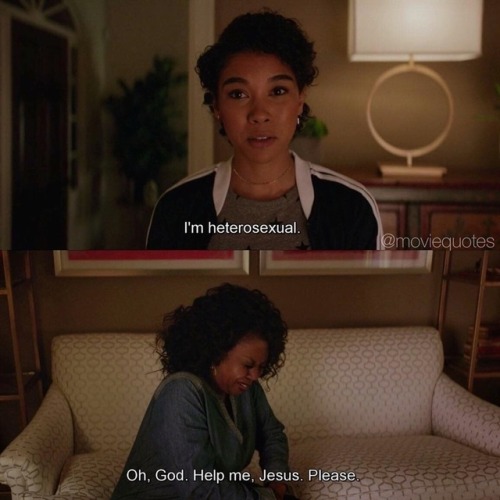
While it is meant to be a humorous component of the film, the scene where Simon questions the act of coming out is nonetheless an important one to note. When reflecting on how big of a deal it is to come out, Simon wonders why this pressure is only one felt by queer people. What ensues is a montage of his straight friends coming out to their parents as heterosexual, while the reactions mimic the ones often given to queer people. By challenging the entire concept of coming out, the film delves into the issue of assumed or compulsive heterosexuality. All too often, heterosexuality “remains, for the most part, relatively unquestioned,” however, “accepting that heterosexuality is “natural” or “normal” does not simply make it so” (Sullivan 119). This notion is exhibited in the film when Simon’s father assumes he is looking at pictures of female models at the beginning of the film. Also, when Blue’s post is seen (and even when Simon is outed) the entire school becomes absorbed by it. Up until this point they have merely assumed that all of their classmates were straight until proven otherwise. This illustrates how being straight is perceived as the norm, which therefore leads all other sexualities to be labelled as “other” in regards to this societal standard. This is obviously problematic as it not only makes queer people feel they need to hide who they are, but also in that it results in the victimization of queer identities.
Love, Simon is a romantic comedy for queer people. Although it is often viewed as a soft queer film, it is nevertheless a story that needs and deserves to be seen. This film provides a balance in regards to the other, more serious movies we have watched in this course. However, just because this film is lighthearted does not mean it is not necessary or relevant. In the movie Blue (who is eventually revealed to be Bram after all) and Simon give each other the courage to be themselves, which is one of the many reasons why stories like this one need to be told. Due to the fact that we are “never simply consumers of popular cultural texts, but in and through our very ‘reading’ of them we actively (re)create them” (Sullivan 189), more films like this need to be made. If more queer stories are told, it starts an open conversation about them. Furthermore, showing stories that have a happy ending for a change helps queer people envision one of their own. This film deserves to be seen by everyone, regardless of race, gender, sexuality, etc.–both parents and children alike.

Works Cited
Burke, Kenneth. “”Terministic Screens.” Language as Symbolic Action; Essays on Life, Literature, and Method. University of Pennsylvania, 1968, 44-62.
Love, Simon. Directed by Greg Berlanti. Performances by Nick Robinson, Jennifer Garner, and Josh Duhamel. 20th Century Fox, 2018.
Sullivan, Nikki. “Queering ‘Straight’ Sex.”A Critical Introduction to Queer Theory. New York University Press, 2003, 119-135.
Sullivan, Nikki. “Queering Popular Culture.” A Critical Introduction to Queer Theory. New York University Press, 2003, 189-206.

 Queer Cinema
What you said about the montage of the straight kids coming out is really interesting. I’ve heard of people jokingly “coming out” as straight in real life to make fun of the coming out experience. Some people had problems with this movie before it even came out because of this scene in the trailers. But your take on it illustrates what the movie is actually trying to say. No one ever has to come out as straight because everyone is already assumed to be straight. Queer people might not have to come out if we just stopped buying into compulsory heterosexuality. This scene is not trivializing coming out, it’s telling parents not to pressure their kids to be straight, or to assume they already are.
LikeLiked by 1 person
I really enjoyed your conversation about the necessity of more queer films needing to be made. I think there is a lot to be said about normalizing queerness. I hate the use of the word because normalization normally means assimilation, but I think it is important to share queer stories frequently and truthfully, just as the stories of straight lives are shared. In this sense, queer liberation can become a form of normalization in society. Celebrating queer lives should be normal, and I think this film shares one such story well. Thanks for sharing!
LikeLiked by 1 person
Your commentary on coming out is excellent. I did not see Simon’s feelings on coming out as apologetic or as him wishing he was more like straight people. Rather, I saw it as the film trying to say “Hey! Straight isn’t the default! Some people are gay!” which, obviously, is what gay people have been saying forever. This film repeats the idea that gay people are just like everyone else, but not in a forceful conforming way. Rather, it encourages audiences to understand that straight is not the default, and to acknowledge identities other than the norm.
LikeLiked by 1 person